All models
Every model's ID, minimum plan and monthly allowance on Go, Plus and Pro.
Two weeks after Argon, Google shipped Carbon. It took first place on two leaderboards on day one, and it's now open to every paying developer at Argon's price. Google's own advice is still to use Argon for most work. Where Carbon is strong, where it isn't, why the bill is bigger at the same price, and when to switch.
Gemini 4 Carbon launched on October 28, and by the end of the day Google held first place on both the Artificial Analysis Intelligence Index and Arena's Text leaderboard. Gemini 4 Argon had shipped just two weeks before.
At launch, only a small group of cyber defenders could use it. Everyone else got the scores and nothing to run. On November 10, Google opened the API to every paying developer, and the price didn't move: same as Argon, $2 input and $10 output per million tokens.
Same price, better model, so why not switch? Google answered that itself. Its announcement says Argon remains the better choice for most software engineering and knowledge work. Carbon is for the hard problems, and it spends far more tokens than Argon exploring, reasoning and checking its work.
The short version: Carbon is for hard problems, not a drop-in replacement for Argon. Cross-module refactors, bugs you can't trace and long agent runs go to Carbon. Everyday edits and tests stay on Argon. The per-token price is low, but Carbon thinks long and writes a lot, so a task adds up, and the per-token price doubles on December 1. It's on Go, Plus and Pro on CodingPass.
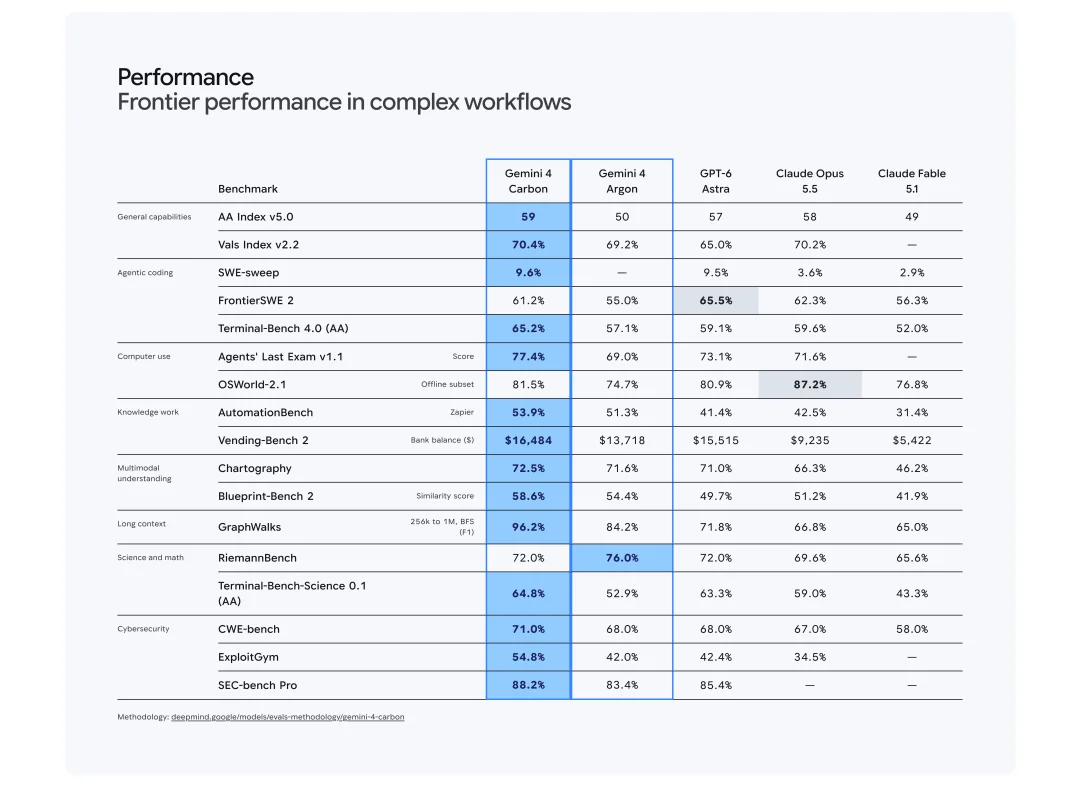
If you write code, three rows matter most.
Agentic coding in the terminal. 65.2% on Terminal-Bench 4.0: 5.6 points ahead of Opus 5.5 and about 8 ahead of Argon. No other row puts more distance between Carbon and Argon.
Long context. 96.2% on GraphWalks (256k to 1M), against 84.2% for Argon and 66.8% for Opus 5.5. Jumping around a large repository and tracing links across files, it barely slips.
Cybersecurity. First on finding, exploiting and patching vulnerabilities, all three. This is what Google most wanted to show off, but these scores were measured without guardrails, and the full cyber capabilities are only available by applying to the Fairwind Program.
It doesn't win everything. On FrontierSWE 2, which fixes real repositories, GPT-6 Astra (65.5%) and Opus 5.5 (62.3%) both beat its 61.2%. On OSWorld computer use, Opus 5.5 leads by almost 6 points. On RiemannBench, Carbon even loses to Google's own Argon.
And first place lasted two weeks. Claude Fable 5.2 came out on November 10, and the Artificial Analysis Intelligence Index now has Fable 5.2 at 65 and Carbon at 60.
Closer to day-to-day use than any benchmark is Arena's Agent leaderboard. It counts one thing: whether the problem actually got solved in real users' agent sessions.
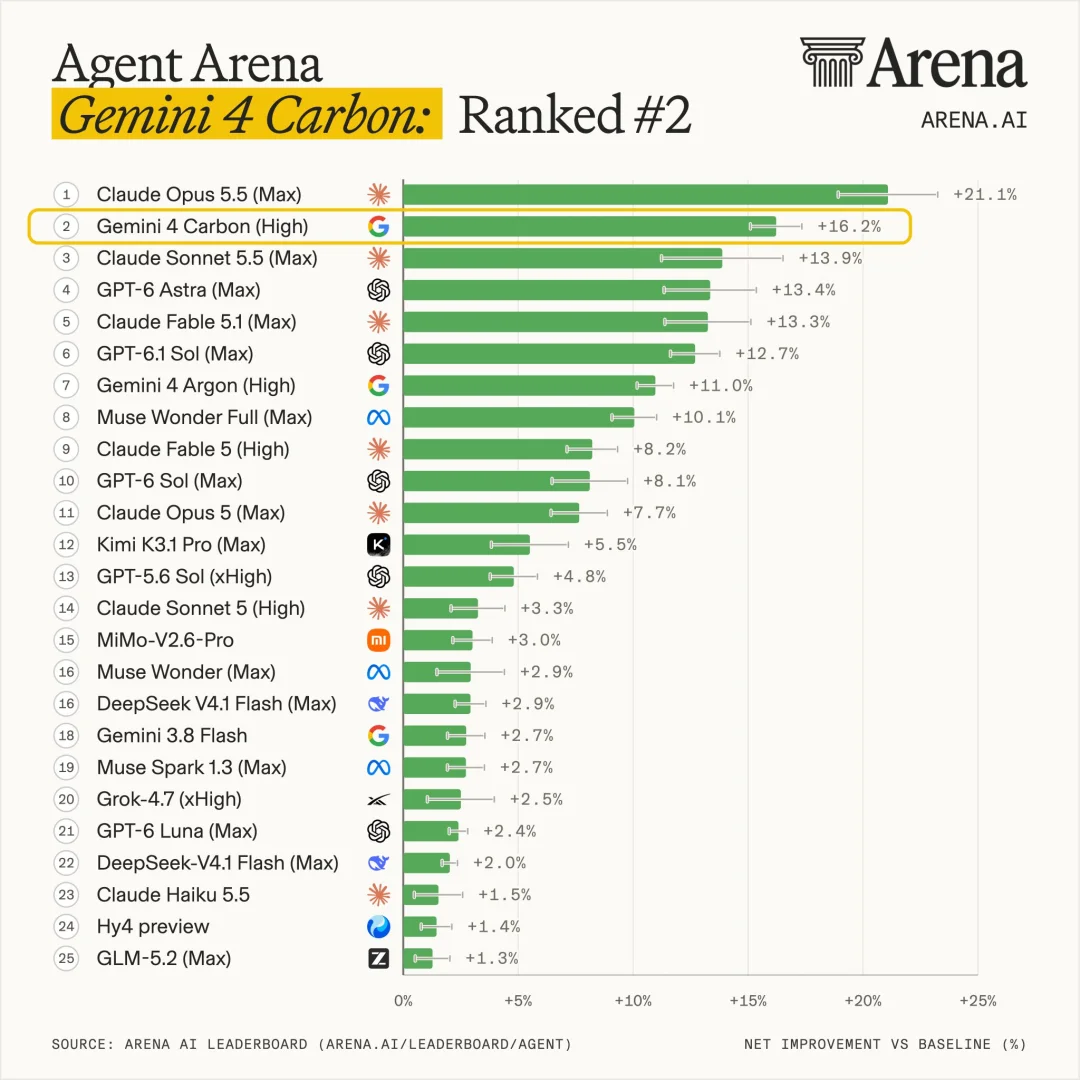
Carbon is second, behind only Opus 5.5 Max. Argon is seventh. Arena also broke out one signal on its own: when the user changes the requirements or pushes back mid-task, does the model listen and change course? Carbon is first on that one.
Peter Gostev, who leads capability evaluation at Arena, had been using Carbon before launch. In his words, it "feels a lot better than Argon", and "this is a real deal from Google this time."
The catch shows up in every account: it's slow. Lumina, an evaluator who built 3D scenes with Carbon on Arena, found it clearly better than Argon but incredibly slow, 2 to 4 times slower depending on the task.
Carbon and Argon cost the same per token. The whole difference is how many tokens.
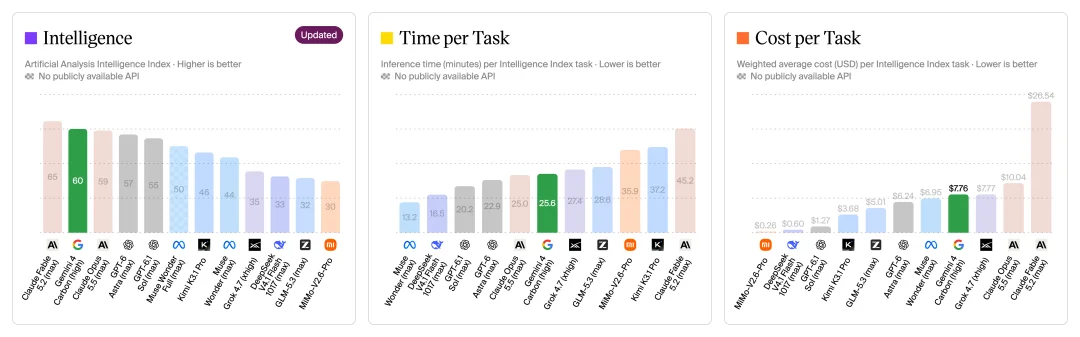
Across the full Intelligence Index run, Carbon produced 205 million output tokens. The median for models in its class is 72.8 million, so that's about 2.8 times as many. A task took 25.6 minutes on average, against a median of 12.6.
Google's pricing page doesn't hide it either: on the same task, Argon uses fewer tokens per turn and answers faster. More tokens means more money and more waiting. Arena says Carbon's cost per task is 72% lower than Opus 5.5 Max's. That's accurate, but it's measured against the most expensive setting there is, not against Argon.
$2 / $10 is an introductory price. Google's pricing page spells it out: from December 1, Carbon and Argon both go to $4 input and $20 output per million tokens, and cache reads go from $0.10 to $0.20.
Artificial Analysis's $7.76 per task is already at the new price.
On CodingPass, Carbon has three reasoning efforts, low, medium and high, and thinking can't be turned off:
reasoning_effort (Chat Completions), reasoning.effort (Responses) or output_config.effort (Messages), and it runs at the level you picked.none, or thinking set to disabled), and it runs at low, the lowest level.Start at medium. Carbon's strength is not letting go of a hard problem, but most requests don't need the long stretch of thinking it does at high. Move up when it gets stuck.
curl https://codingpass.ai/v1/chat/completions \ -H "Authorization: Bearer $CODINGPASS_API_KEY" \ -H "Content-Type: application/json" \ -d '{ "model": "gemini-4-carbon", "reasoning_effort": "medium", "messages": [{"role": "user", "content": "Find the root cause of the flaky test in tests/sync.test.ts"}] }'In OpenCode, Cline and other OpenAI-compatible tools, add gemini-4-carbon to the model list and you're set.
Argon stays the default. Google says so, and the token math agrees. Argon is fast, and the same allowance gets more done.
Bring in Carbon when you're stuck. Changes that span several modules, a bug you've chased all afternoon, an agent task that has to run for a long stretch: these are worth the extra wait and the extra allowance.
Run the heavy jobs in November. CodingPass meters at official API prices, so once the price per token doubles on December 1, the same allowance covers half as many tokens.
Go, Plus and Pro all include Carbon, metered at official API prices. No surprise charges, cancel anytime.