All models
Every model's ID, minimum plan and monthly allowance on Go, Plus and Pro.
Anthropic released Claude Fable 5.2. It clearly beats the last generation on coding, computer use and robotics, matches Opus 5.5 Max at High effort, and the official price drops 20%. Here are the official numbers, which effort level to use, how to run it on Pro, and our take after a few days with it.
Anthropic released Claude Fable 5.2 alongside Claude Mythos 5.2. Both run on the same underlying model: Fable ships with strict cybersecurity and biosecurity safeguards and is open to everyone, while Mythos drops some of those safeguards and is only for organizations in Anthropic's cyber verification and life sciences programs.
If you write code, Fable 5.2 is the one to look at. It beats Opus 5.5 on almost every capability Anthropic measured, generates up to 30% faster than Fable 5.1, and costs 20% less at official prices. CodingPass Pro's flagship model is now Fable 5.2. This post collects the official numbers, explains which effort level to use and how to run it on Pro, and ends with our take after a few days with it.
In short: on Pro, switch the model ID to claude-fable-5-2. Use Medium effort day to day and Xhigh for hard problems. Official prices drop to $8 input and $40 output per million tokens, and CodingPass meters at official prices, so the same allowance now covers about 25% more tokens.
Anthropic compared Fable 5.2 with Fable 5.1, Opus 5.5, GPT-6 Astra and Gemini 4 Carbon. The green column is Fable 5.2.
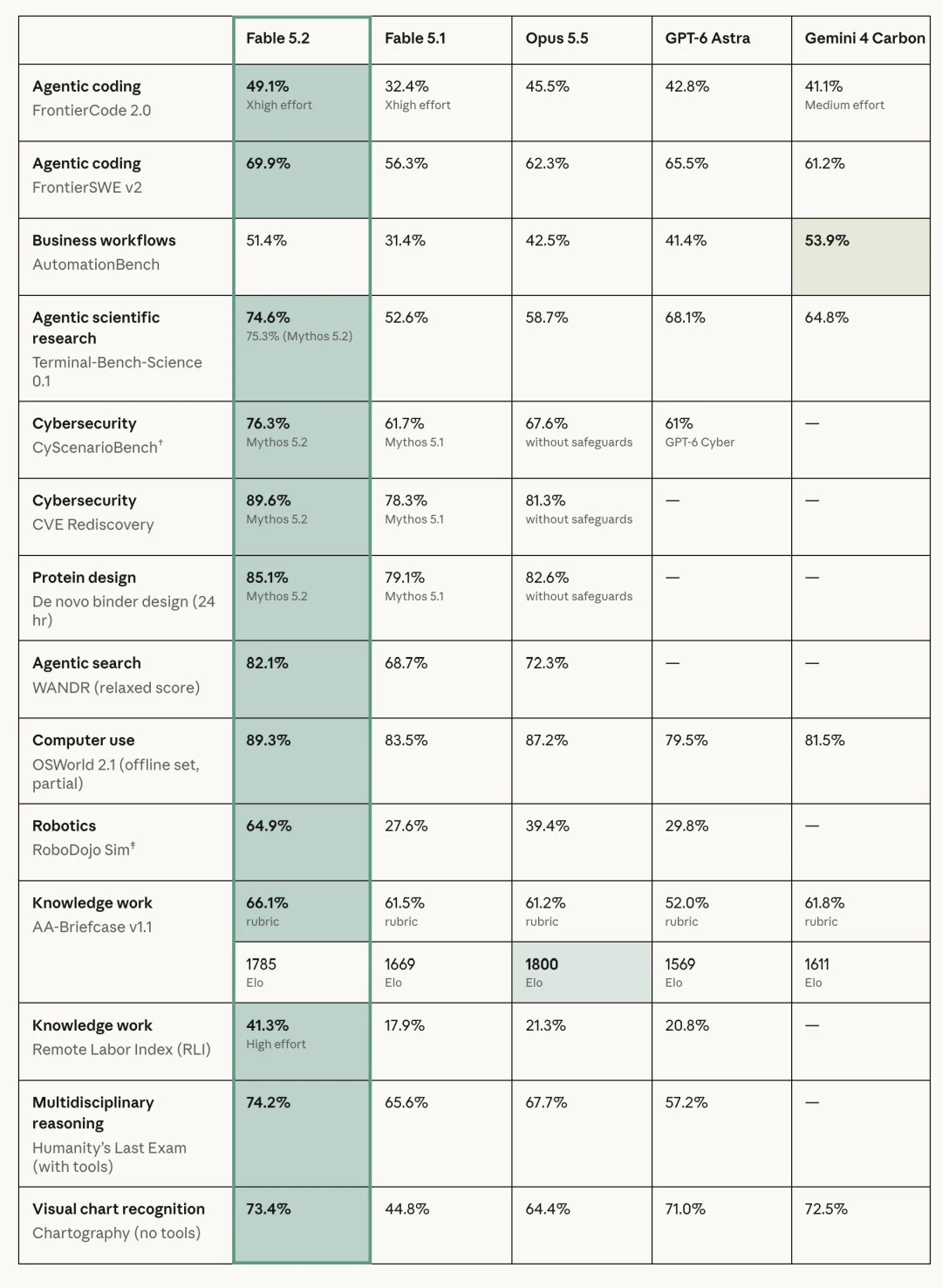
The rows that matter most for coding:
Coding. 49.1% on FrontierCode 2.0 (Xhigh) and 69.9% on FrontierSWE v2, the top scores in the comparison. Opus 5.5 scores 45.5% and 62.3%, GPT-6 Astra 42.8% and 65.5%.
Computer use. 89.3% on OSWorld 2.1, against 87.2% for Opus 5.5.
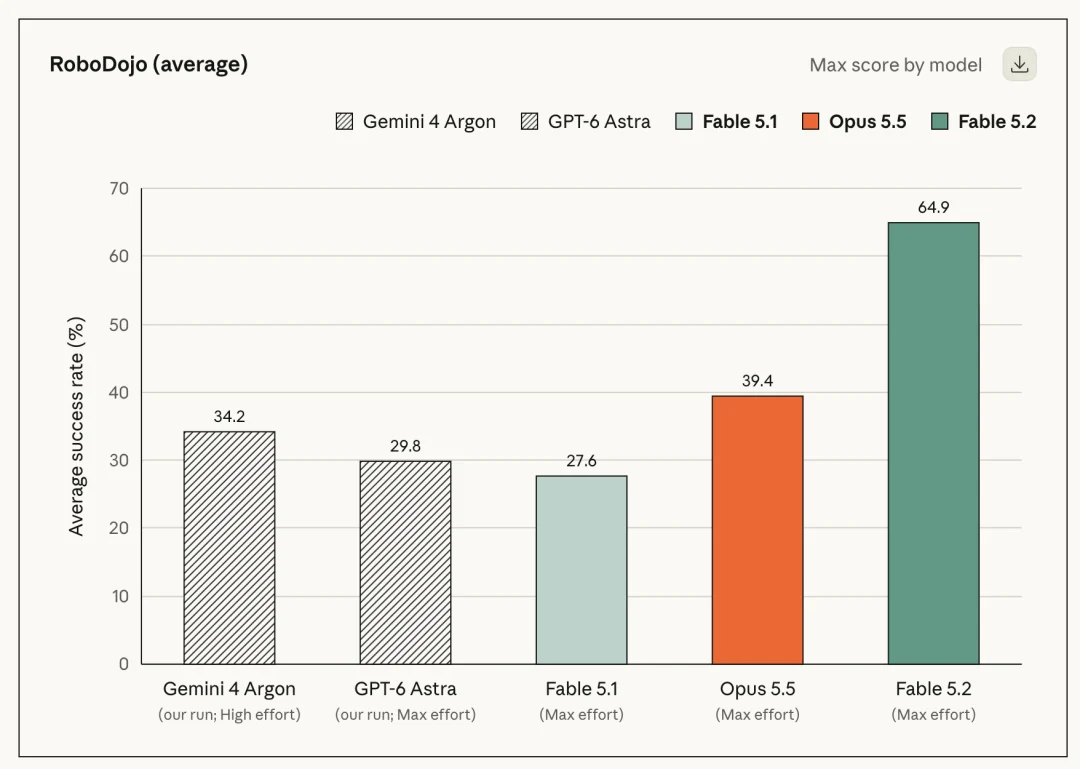
Robotics. RoboDojo Sim goes from 27.6% on Fable 5.1 to 64.9%, the biggest jump in this release.
Not first everywhere. On AutomationBench, Gemini 4 Carbon's 53.9% beats Fable 5.2's 51.4%, and on AA-Briefcase Elo, Opus 5.5's 1800 edges out Fable 5.2's 1785. The top cybersecurity and protein design scores belong to Mythos 5.2, not Fable.
The most useful chart in this release plots FrontierCode 2.0 scores against cost per task.
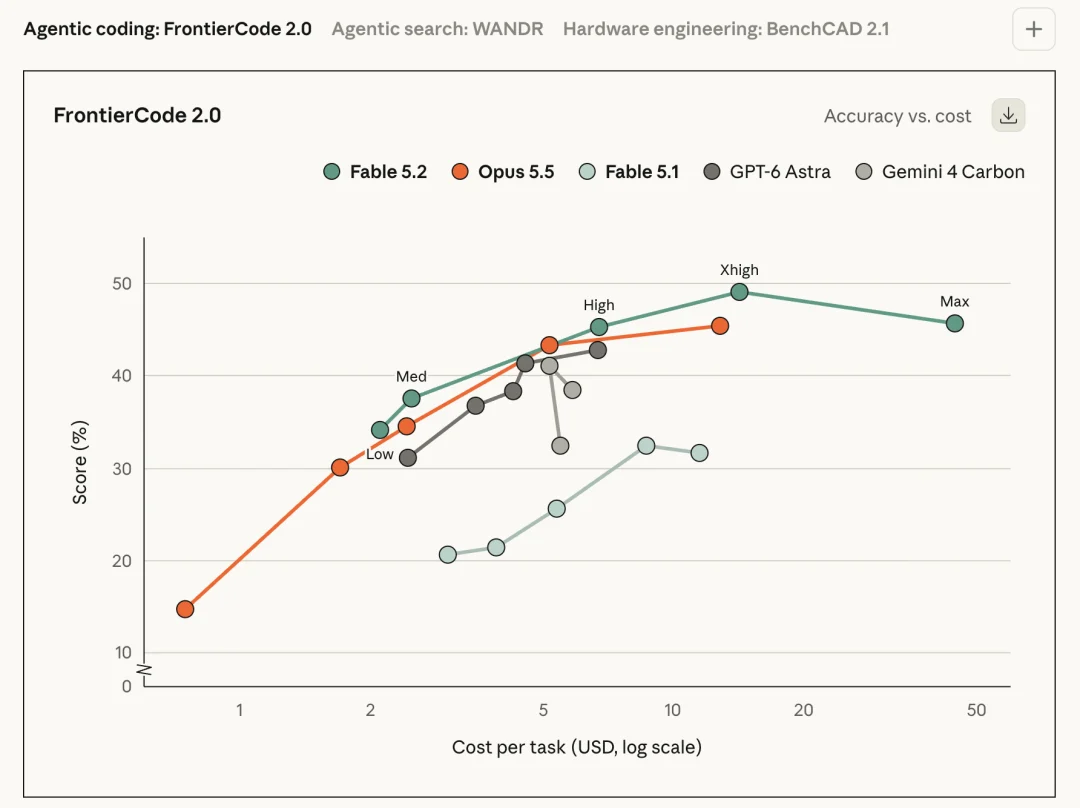
Medium is the default in the Claude apps and Claude Code. At this level, Fable 5.2 uses fewer tokens than Fable 5.1 to finish hard tasks.
High scores about the same as Opus 5.5 at Max, for roughly half the cost per task.
Xhigh beats every released model at every effort level.
Max scores slightly lower than Xhigh at about 3 times the cost. The top setting isn't the best one.
Official prices drop from Fable 5.1's $10 input and $50 output per million tokens to $8 and $40. There's also an optional Fast Mode that generates up to 2.5 times faster at double the price.
| Model | Input | Output |
|---|---|---|
| Fable 5.2 | $8 | $40 |
| Fable 5.2 Fast Mode | $16 | $80 |
| Fable 5.1 | $10 | $50 |
CodingPass meters every allowance at each vendor's official API prices, so the price cut goes straight to your allowance: the same $500 of Fable covers about 25% more tokens at $8 / $40 than it did at $10 / $50.
The announcement has plenty of examples. These are the most relevant to engineering.
Python to Rust. A team of agents running an early version of Fable 5.2 moved a critical production service from Python to Rust. It got faster and more reliable, and now starts about 26 times faster.
An operating system from an empty folder. Fable 5.2 coordinated more than 1,000 subagents writing, testing and reviewing code for 8 days straight, and produced a prototype OS that boots on a laptop: its own kernel, disk, keyboard and network drivers, persistent file storage, a window system, a login screen and an installer.
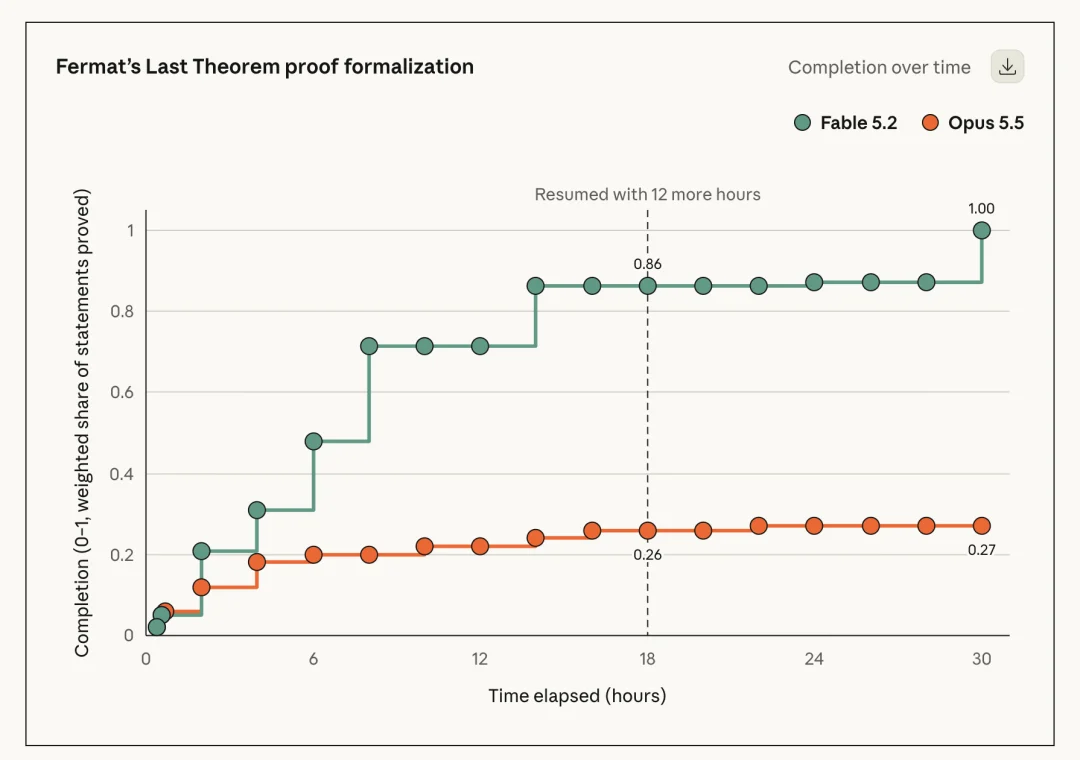
Fermat's Last Theorem formalized in 30 hours. 1,000 Fable 5.2 agents formalized the whole theorem in 30 hours with almost no human input. With the same setup, Opus 5.5 finished 26% in 18 hours and barely moved after that.
Hardware. From a short prompt, Fable 5.2 wrote the specs, picked the parts, laid out four-layer circuit boards, modeled the enclosures and wrote the software for three working devices: a home voice assistant hub, a USB speakerphone and a handheld virtual pet. None of the circuits needed a change.
Robotics. On RoboDojo, Fable 5.2 controls a simulated two-armed robot from camera images and averages a 64.9% success rate, ahead of the other frontier models on the same harness.
Fable 5.2 is on Pro, at $100 a month.
Connect to CodingPass. If you haven't yet, set ANTHROPIC_BASE_URL and ANTHROPIC_AUTH_TOKEN. The steps are in the Claude Code setup guide.
Switch the model ID. Pass it at launch, or switch mid-session.
claude --model claude-fable-5-2 # at launch/model claude-fable-5-2 # mid-sessionKeep the request ID. Every response carries an x-request-id header. It's the same ID you'll find in your usage log in the dashboard, so you can look up that request there, and support can too.
Codex, OpenCode and Cline work the same way: add claude-fable-5-2 to the model list.
Here's how it felt after a few days of daily use. It's an impression, not a benchmark.
Medium is enough for daily work. Fable 5.2 at Medium is steadier than Opus 5.5 at High, and faster. For bug fixes, features and tests, there's no need to go higher.
Save Xhigh for the hard problems. Every week brings one or two problems Opus can't crack: a cross-module refactor, an intermittent bug with no obvious cause, a feature that needs a big chunk of old code understood first. Xhigh often gets a solid plan in one pass. Don't rush to Max; the cost chart above shows it doesn't pay off.
It handles vague requirements. We used to break tasks down in detail. Now a direction is enough: it fills in the assumptions and lays out a plan before it starts. Its engineering judgment is a clear step up, and Anthropic calls this out too.
The allowance still goes fast. Lower prices or not, running agents on Xhigh for hours burns through it quickly. Our approach: hard problems go to Fable 5.2, everyday work to Opus 5.5 or Sonnet 5.5, switching with /model in Claude Code.
Don't expect security research. Most vulnerability reproduction and penetration testing tasks get blocked by the safeguards. That's the split between Fable and Mythos, not a bug.
Hardware was the surprise. Circuit boards, enclosures and embedded software went further than we expected. If you work on hardware or embedded systems, it's worth a dedicated try.
A new model is a good excuse to clear out the backlog of problems you've been putting off.
Pro includes Fable 5.2, metered at official API prices. No surprise charges, cancel anytime.