All models
Every model's ID, minimum plan and monthly allowance on Go, Plus and Pro.
Google's fourth Gemini 4 model in seven weeks sits between Carbon and Hydrogen. Official benchmarks, Artificial Analysis cost and time per task across four thinking levels, pricing vs. Carbon, monthly bill estimates, and what the model card leaves pending.
On November 18, Google released Gemini 4 Neon—its fourth Gemini 4 model in seven weeks. Adapted from Carbon, it sits between the flagship Carbon and the faster Hydrogen.
On launch day, Neon scored 61 on the Artificial Analysis Intelligence Index (#3 overall, 1 point ahead of Carbon) and 70.9% on the Vals Index (#2). API pricing is $3 per million input tokens, $15 per million output tokens, and $0.15 for cached input, with a 1-million-token context window.
Bottom line: At its default high thinking level, Neon matches Carbon on the Intelligence Index at less than half the cost and time per task, making it the practical default for multi-file debugging, refactors, and long-running agents. Stepping up to xhigh adds 1 point for 70% more cost per task. Through November 30, Carbon's $2 / $10 introductory rate still makes Carbon cheaper per token. CodingPass includes Neon on Go, Plus, and Pro.
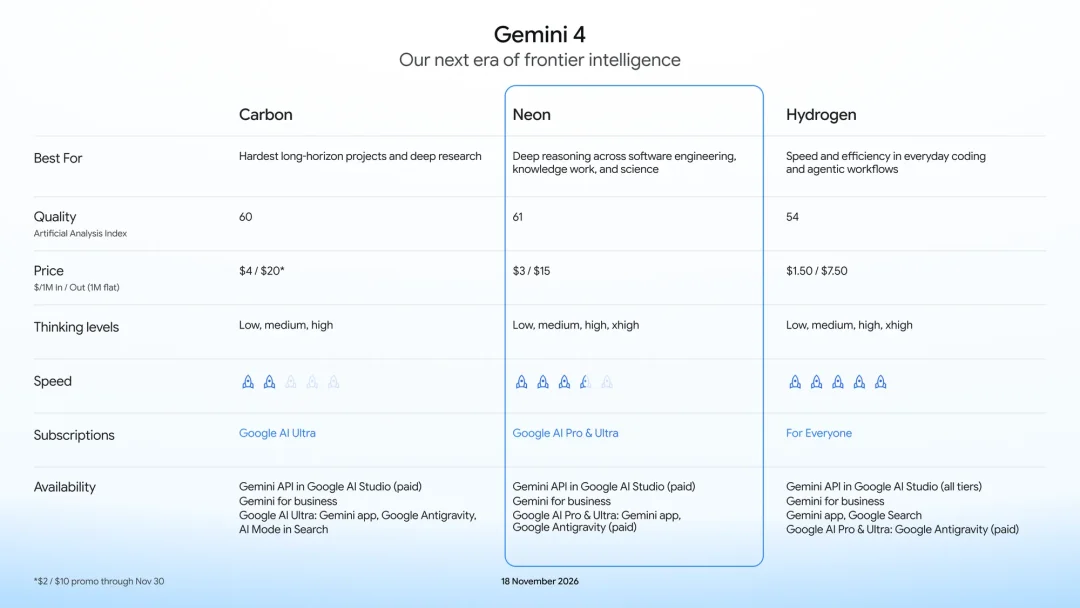
The division of labor is straightforward: Carbon takes the hardest long-horizon work, Hydrogen handles fast everyday execution, and Neon fills the gap for complex coding and long-running agents where Carbon is too slow and expensive.
| Carbon | Neon | Hydrogen | |
|---|---|---|---|
| Positioning | Hardest long-horizon projects and deep research | Complex coding, knowledge work, and scientific reasoning | Everyday coding and agent workflows, built for speed and cost |
| AA Intelligence Index | 60 | 61 | 54 |
| API pricing (input / output, per 1M tokens) | $4 / $20 ($2 / $10 through Nov 30) | $3 / $15 | $1.50 / $7.50 |
| Thinking levels | low, medium, high | low, medium, high, xhigh | low, medium, high, xhigh |
| Gemini app subscription | Google AI Ultra | Google AI Pro and Ultra | Everyone |
Neon accepts text, images, video, audio, and PDFs, and outputs text only. It has a 1,048,576-token context window, with 65,536 default synchronous output tokens and up to 1 million via background long decode. Supported tools include Computer Use, code execution, file search, function calling, structured outputs, and Grounding with Google Search and Maps; image generation, audio generation, and the Live API are not supported. Its knowledge cutoff is March 2026.
Argon is missing from the chart. The Gemini app model picker now shows four options—Auto, Hydrogen, Neon, and Carbon—removing both 3.1 Pro and Argon, a change some Pro subscribers only noticed upon opening the app. Argon remains on the API pricing page at the same rates as Carbon.
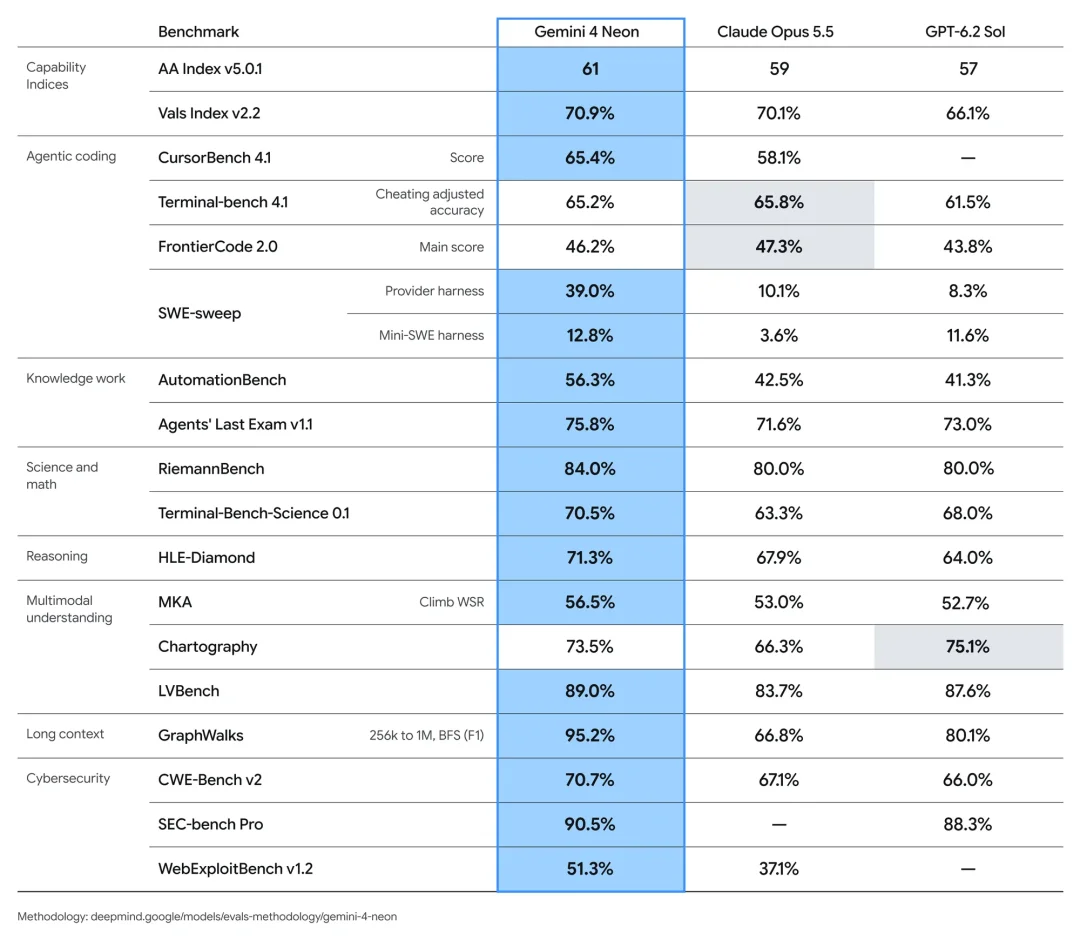
Google's table pits Neon against just two models: Claude Opus 5.5 and GPT-6.2 Sol. Neither GPT-6.2 Astra (62) nor Claude Fable 5.2 (65)—the two models ahead of Neon on the AA Intelligence Index—appears in the comparison. Google frames Neon as leading comparable models and trailing only larger, slower ones. By Artificial Analysis figures, however, Astra (Max) costs $4.00 and takes 11.5 minutes per task, making it both cheaper and faster than Neon at xhigh ($6.44, 22.6 minutes).
Two of the three rows Neon lost are coding benchmarks:
high setting) vs. Opus 5.5's 47.3%.Neon's widest leads are in long context and automation: 95.2% on GraphWalks (256k to 1M), compared with 66.8% for Opus 5.5 and 80.1% for Sol; and 56.3% on Zapier's AutomationBench, where both rivals sit around 42%.
Third-party rankings outside the table show a similar picture:
Artificial Analysis also published its own knowledge work results:
high, 5 percentage points above Carbon.Neon is built for long-running agent workflows: it sustains tool-heavy runs without stalling mid-task, cuts down on redundant file reads, reports progress as it works, and handles context compaction reliably in long sessions. Across repositories, it makes targeted, surgical edits without refactoring unrelated code. Multi-step instruction following is tighter too, with Google recording its lowest fabrication rate yet in internal Google Antigravity testing.
Key coding benchmarks:
xhigh) with Antigravity CLI scores 59, matching Claude Fable 5.2 (xhigh, 58) and Claude Opus 5.5 (Max, 58) in Claude Code. The separator is cost: Neon averages $6.86 per task vs. $12.61 for Opus 5.5 and $15.47 for Fable 5.2.That 39.0% SWE-sweep result was measured inside Antigravity. On the standardized mini-SWE harness, Neon scores 12.8% against Sol's 11.6%—a 1.2-point gap. Google notes that the 39.0% figure shows what the Antigravity harness unlocks; outside Antigravity, 12.8% is closer to the underlying model baseline.
On Vals's Terminal-Bench 4.0 run, Neon scores 61.62%, ranking #7 out of 69 models.
Google Antigravity also ships a split-model pattern for Neon and Hydrogen: Neon acts as the Orchestrator handling planning and architecture, while parallel Hydrogen subagents run routine code edits, dependency updates, and tests, handing back to Neon to inspect state and revise the plan if Hydrogen gets stuck.
Keep an eye on output token volume when migrating from Argon. In hands-on tests running the same generation tasks, Carbon, Hydrogen, and Neon all consumed 3 to 4 times as many tokens as Argon. That comes from a single-product sample, but the direction aligns with AA's finding that Neon outputs even more tokens per task than Carbon.
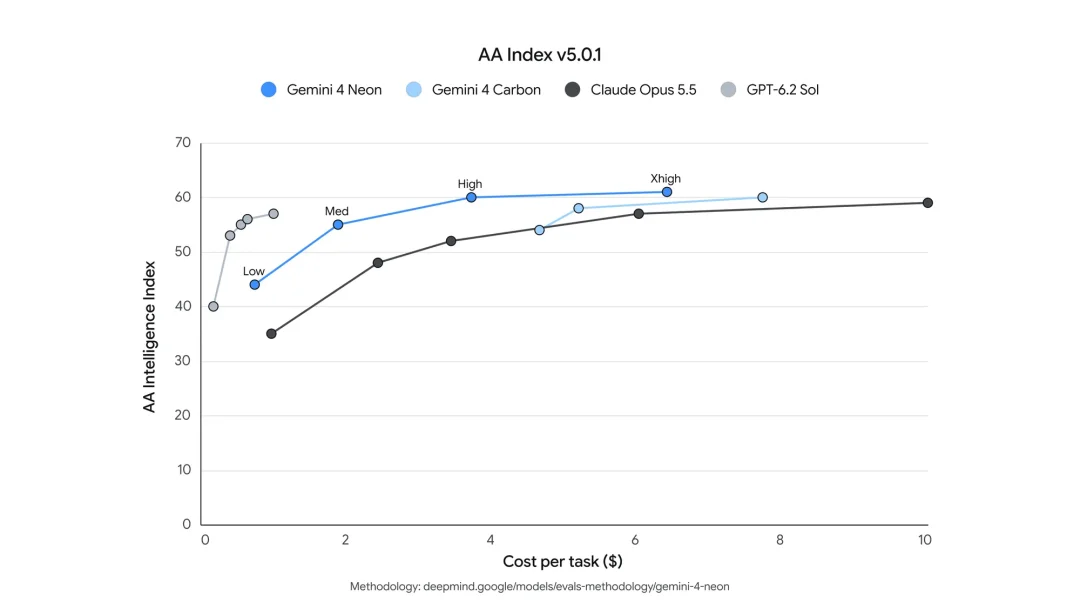
Neon exposes four thinking levels—low, medium, high, and xhigh—and defaults to high. Since Argon defaults to medium, teams switching from Argon who want to keep latency and spend in check should explicitly set medium.
Artificial Analysis benchmarked all four levels:
| Model (level) | AA Intelligence Index | Cost per task | Time per task |
|---|---|---|---|
| Gemini 4 Neon (low) | 44 | $0.75 | 3.7 min |
| Gemini 4 Neon (medium) | 55 | $1.90 | 8.3 min |
| Gemini 4 Neon (high, default) | 60 | $3.74 | 14.8 min |
| Gemini 4 Neon (xhigh) | 61 | $6.44 | 22.6 min |
| Gemini 4 Carbon (high) | 60 | $7.76 | 34.2 min |
| Gemini 4 Hydrogen (xhigh) | 54 | $3.16 | 14.9 min |
| GPT-6.2 Sol (Max) | 57 | $1.01 | 7.9 min |
| GPT-6.2 Astra (Max) | 62 | $4.00 | 11.5 min |
| Claude Opus 5.5 (Max) | 59 | $10.04 | 24.5 min |
| Claude Fable 5.2 (Max) | 65 | $26.54 | 41.1 min |
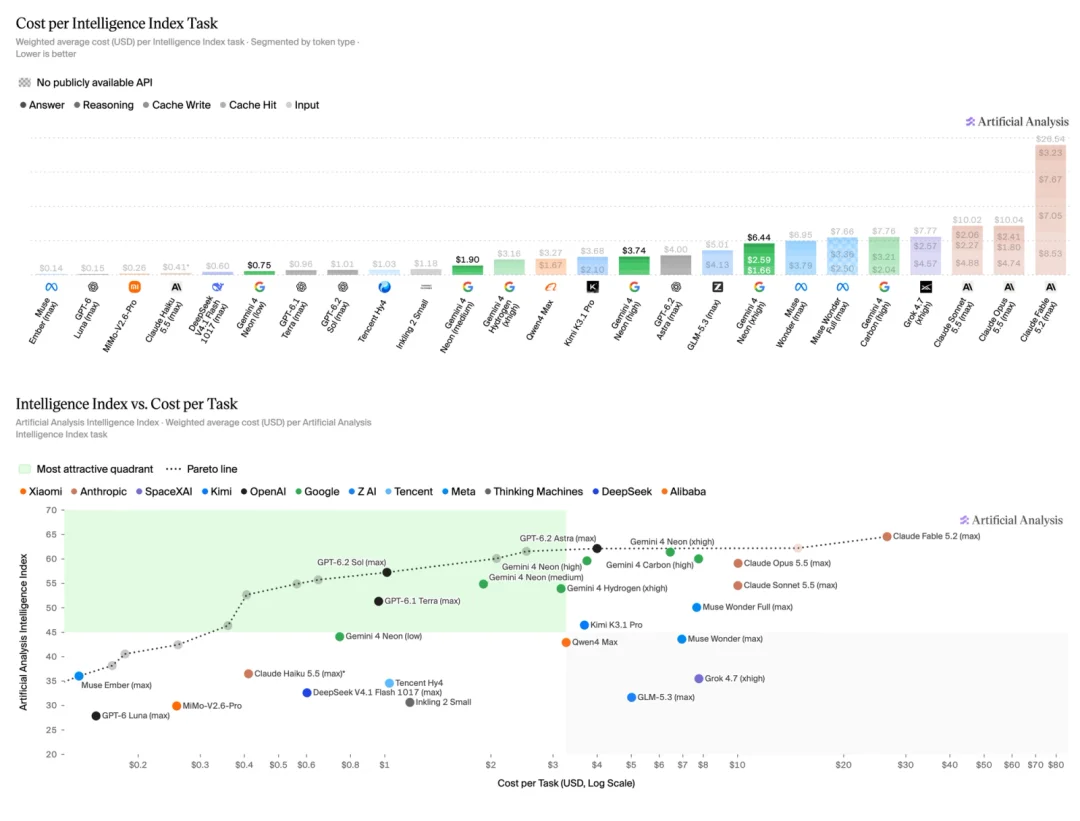
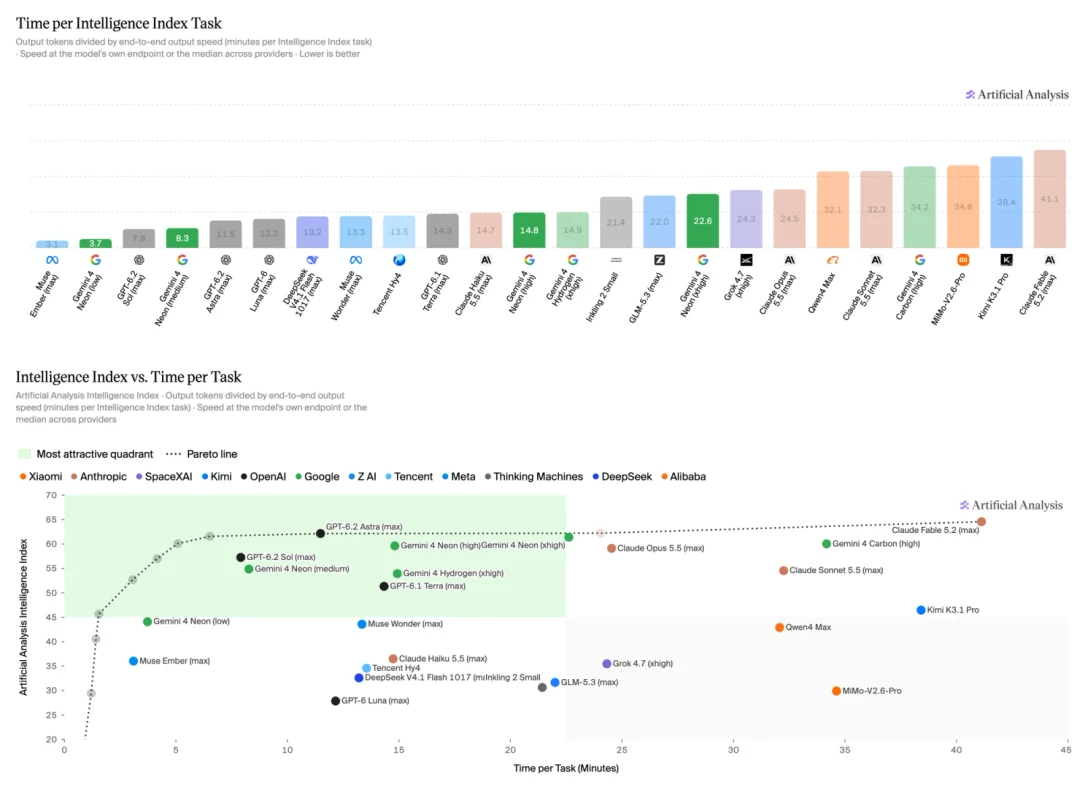
high is the sweet spot: it ties Carbon (high) on intelligence while cutting both cost and runtime by more than half. xhigh is a poor trade—70% higher cost for 1 extra point—and on GDP.pdf it actually scores lower than high (28.0% vs. 33.4%).
The savings come from unit price. AA's data shows Neon generates about 15% more output tokens per task than Carbon; the lower bill comes from 25% lower token prices, and the shorter runtime comes from faster generation (~110 output tokens/sec vs. Carbon's ~57).
Carbon's $7.76 assumes December's price hike. Through November 30, Carbon is still on its half-price introductory rate (~$3.88 per task), which is cheaper than Neon xhigh and roughly even with Neon high.
At the budget end, Sol is cheaper. GPT-6.2 Sol (Max) scores 57 at $1.01 and 7.9 minutes per task, compared with Neon medium at 55 and $1.90.
Google's own post cites slightly different comparisons: high runs 32% cheaper per task than Carbon; on the Vals Index and Agent Arena, high sits on the Pareto frontier at roughly 50% to 80% lower cost per task than leading rivals; and xhigh is 36%+ cheaper than competing models at their highest setting.
On other workloads, the cost ranking can flip. On Plotly's 43-question data analytics benchmark, all four Gemini 4 models earned an A, with total spend coming out to Hydrogen $6, Carbon $11, Argon $13, and Neon $17—making Neon the priciest. Two factors explain this: Carbon and Argon are still at introductory half-price rates, and the benchmark's guided prompts let every model pass, turning total cost into a function of default output and thinking verbosity—where Neon's default high setting spends the most tokens.
| Model | Input | Output (including thinking tokens) | Cached input |
|---|---|---|---|
| Gemini 4 Hydrogen | $1.50 | $7.50 | $0.075 |
| Gemini 4 Neon | $3.00 | $15.00 | $0.15 |
| Gemini 4 Carbon / Argon (through Nov 30) | $2.00 | $10.00 | $0.10 |
| Gemini 4 Carbon / Argon (from Dec 1) | $4.00 | $20.00 | $0.20 |
Neon is not available on the Free tier, and thinking tokens are billed at the output rate. Context caching is implicit only (shared prefixes of 4,096+ tokens hit automatically at 5% of the input rate); explicit caching is not supported.
Within the Gemini 4 family, Neon's list price is double Hydrogen's. Against Carbon and Argon, Neon is 50% more expensive through November 30, and 25% cheaper starting December 1.
Per-request cost breaks down as:
Request cost = uncached input tokens × input rate + cached input tokens × cache read rate + output tokens × output rateAssuming 20,000 input tokens per request (50% cached) and 2,000 output tokens:
| Model | Per request | 10K requests | 100K requests | 1M requests |
|---|---|---|---|---|
| Gemini 4 Hydrogen | $0.031 | $308 | $3,075 | $30,750 |
| Gemini 4 Neon | $0.062 | $615 | $6,150 | $61,500 |
| Gemini 4 Carbon (through Nov 30) | $0.041 | $410 | $4,100 | $41,000 |
| Gemini 4 Carbon (from Dec 1) | $0.082 | $820 | $8,200 | $82,000 |
These estimates hold output fixed at 2,000 tokens. Higher thinking levels generate more output tokens, pushing real-world bills further toward the output line.
CodingPass meters usage at Google's official API prices. Neon is available starting on Go, while Carbon requires Plus.
| Model | Minimum plan | Go | Plus | Pro |
|---|---|---|---|---|
| Gemini 4 Hydrogen | Go | 305M | 1.0B | 2.5B |
| Gemini 4 Neon | Go | 205M | 508M | 1.3B |
| Gemini 4 Argon | Go | 205M | 761M | 1.9B |
| Gemini 4 Carbon | Plus | — | 761M | 1.9B |
On Go, Neon's monthly allowance is $60—roughly 2,050 requests, with a 5-hour cap of around 342 requests. Once Carbon and Argon rates double on December 1, the same allowance will cover half as many tokens.
curl https://codingpass.ai/v1/chat/completions \ -H "Authorization: Bearer $CODINGPASS_API_KEY" \ -H "Content-Type: application/json" \ -d '{ "model": "gemini-4-neon", "reasoning_effort": "medium", "messages": [{"role": "user", "content": "Refactor src/billing/ to remove the duplicated proration logic"}] }'In Claude Code, run claude --model gemini-4-neon. In OpenCode, Cline, and other OpenAI-compatible clients, add gemini-4-neon to your model list.
Google also built a specialized cybersecurity variant, Gemini 4 Neon for cyber, covering secure code generation, vulnerability discovery, validation, and patching. It is not in the standard API; access opens to trusted defenders over the coming days through the Fairwind Program via Google Cloud account teams.
Google reports #1 scores across secure code generation, penetration testing, and vulnerability discovery: Neon outperforms Carbon across easy, medium, and hard tiers on AutoBaxBench, and runs at roughly half the cost of competing large models on WebExploitBench v1.2 and SEC-bench Pro.
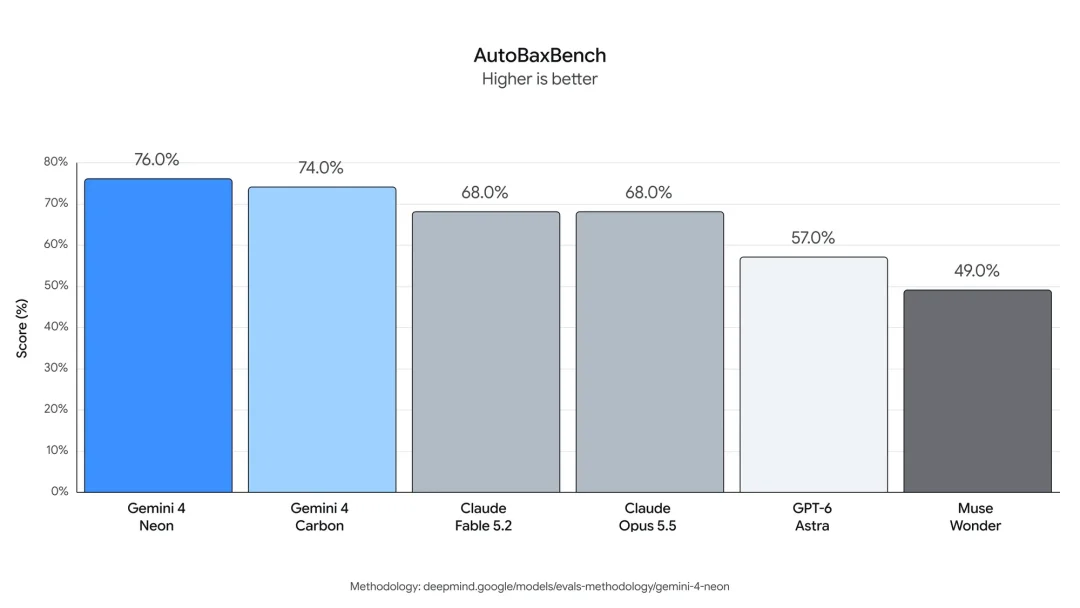
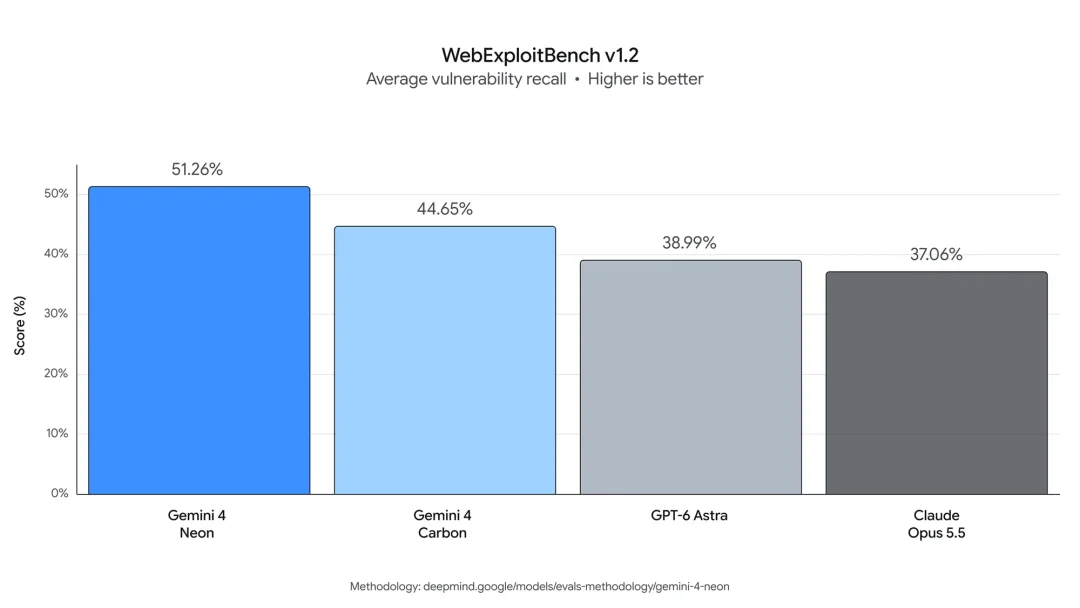
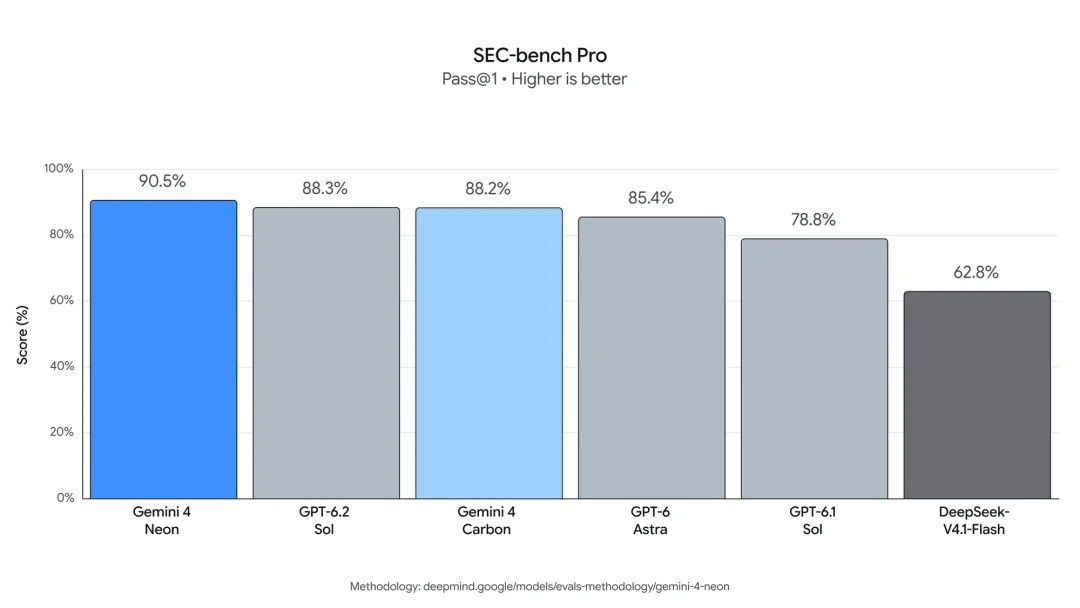
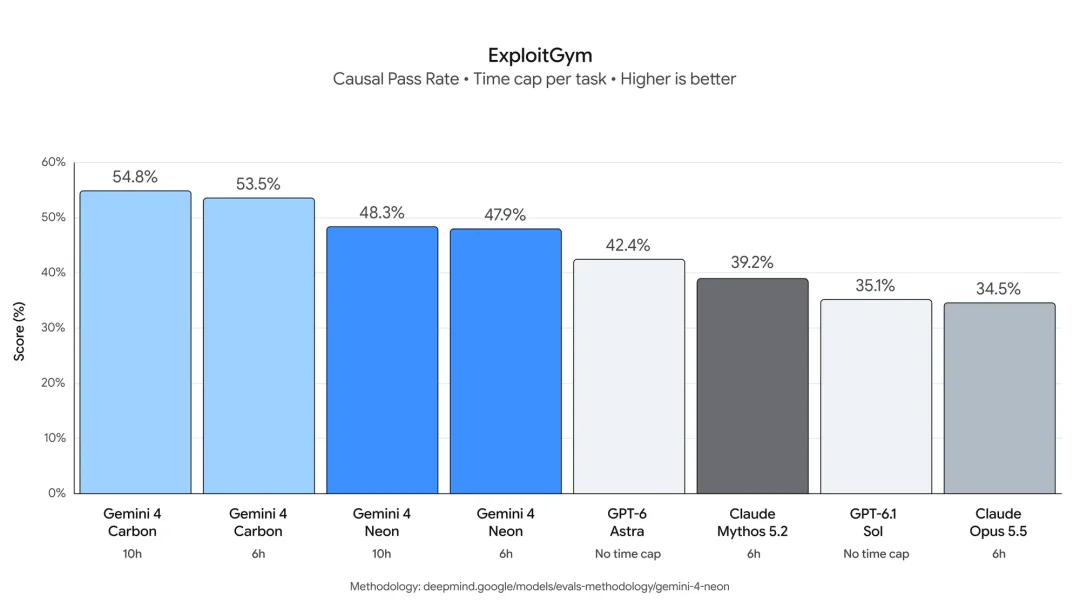
On the remaining two benchmarks, Neon did not take first place. On ExploitGym (validating whether vulnerabilities are exploitable), Neon trails Carbon, though Google emphasizes it used half as many tokens.
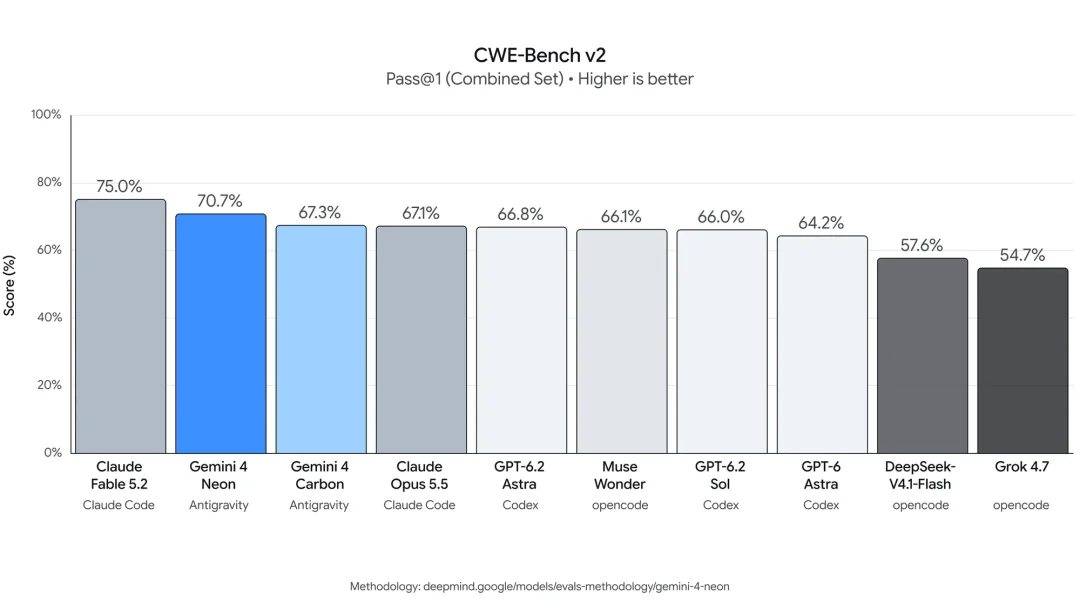
On CWE-Bench v2 (patching vulnerabilities), Neon gains 3.4 percentage points over Carbon, while Claude Fable 5.2 leads overall. Google's main comparison table only lists Opus 5.5 and Sol on this row.
Neon keeps Carbon-level safeguards against severe misuse while cutting unjustified refusals: 1.98% on Terminal-Bench 4.0 and 0% on Terminal-Bench-Science.
Google's agentic behavior evaluations report:
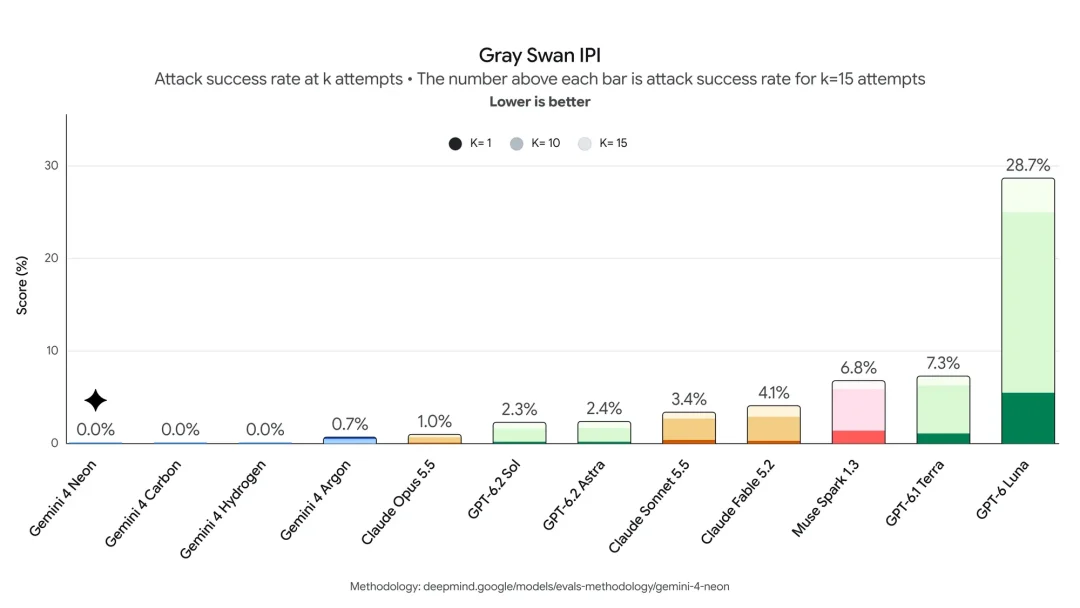
Gray Swan's indirect prompt injection benchmark hides malicious instructions inside web pages, emails, documents, and code read by the model. At xhigh with real-time safeguards enabled, Neon recorded a 0.0% attack success rate.
Most of the figures in this section come from Google's internal evaluations. The model card notes that Neon's full Safety & Security Report will be published "in the coming days," and that Frontier Safety Framework critical capability evaluations were not re-run—Google carried forward Argon's determinations after concluding Neon's gain over Argon fell below the Material Capability Change (MCC) threshold. Under "Known Limitations," the card offers only standard boilerplate ("may exhibit some general limitations such as hallucinations"), leaving finer-grained boundaries until the full safety report is released.
In the Gemini app, Neon maps to "Deeper analysis" in the model picker for Google AI Pro and Ultra subscribers. Google highlights three updates:
Other rollout channels:
On launch day, it remained unclear whether discounted or student Pro plans get Neon in Antigravity: some users could select it, while others saw a message restricting access to paid Pro and Ultra plans.
| Workload | Pick | Why or trade-off |
|---|---|---|
| Everyday edits, tests, and docs | Hydrogen, or Neon at medium | Neon medium scores 55 at $1.90 per task; Hydrogen costs half as much per token |
| Multi-file debugging, repo refactors, long-running agents | Neon at high | Matches Carbon high on the Intelligence Index at under half the cost per task (14.8 min vs. 34.2 min) |
| Hard problems that stay stuck | Neon at xhigh, or Carbon | xhigh adds 1 point over high for 70% more cost; Carbon is cheaper through November 30 |
| Finance, legal, spreadsheets, and dense charts | Neon at high | First on Vals Finance and Legal indices; high beats xhigh on AA's GDP.pdf |
| High-volume, price-sensitive routine calls | Hydrogen, or GPT-6.2 Sol | AA measures Sol (Max) at 57 and $1.01 per task |
| Vulnerability finding, pentesting, and security work | Apply to the Fairwind Program | Neon for cyber is limited to program members and is not in the public API |
For most teams, a practical baseline is moving existing Argon or Carbon workloads onto Neon high, dialing down to medium when allowance is tight, and reserving xhigh for tasks that stall at high.
ANTHROPIC_BASE_URL at CodingPass and launch with claude --model gemini-4-neon. Per-tool configuration snippets are on the models page.gemini-4-argon on CodingPass. Only the Gemini app model picker removed Argon.Go, Plus and Pro all include Neon, metered at official API prices. No surprise charges, cancel anytime.