All models
Every model's ID, minimum plan and monthly allowance on Go, Plus and Pro.
Everyone is still racing to produce more tokens and reason harder. Google shipped a model that writes no answer: give it an input and a few options, and it computes once, tells you which one to pick and how confident it is. 92.2% accuracy on JevBench, $0.10 per million input tokens, and no charge for output.
The industry is still racing to produce more tokens and reason harder. Google's latest release goes the other way: the model does not write its answer at all.
On November 11, Google launched Gemini Decision 1 and the Gemini Decisions API it powers. This model only makes decisions. You list the candidate answers, it runs one forward pass, scores each candidate, and stops.
The short version: Decision 1 writes no text. Give it a few options and it tells you which one to pick. Classification, routing, tool selection and policy checks, the jobs that only need one result, run faster and cheaper on it, and every answer comes with a confidence score. It is not a catch-all, though. On When2Call, which tests whether and when to call a tool, it does not come first.
Google CEO Sundar Pichai introduced it in a post on X.
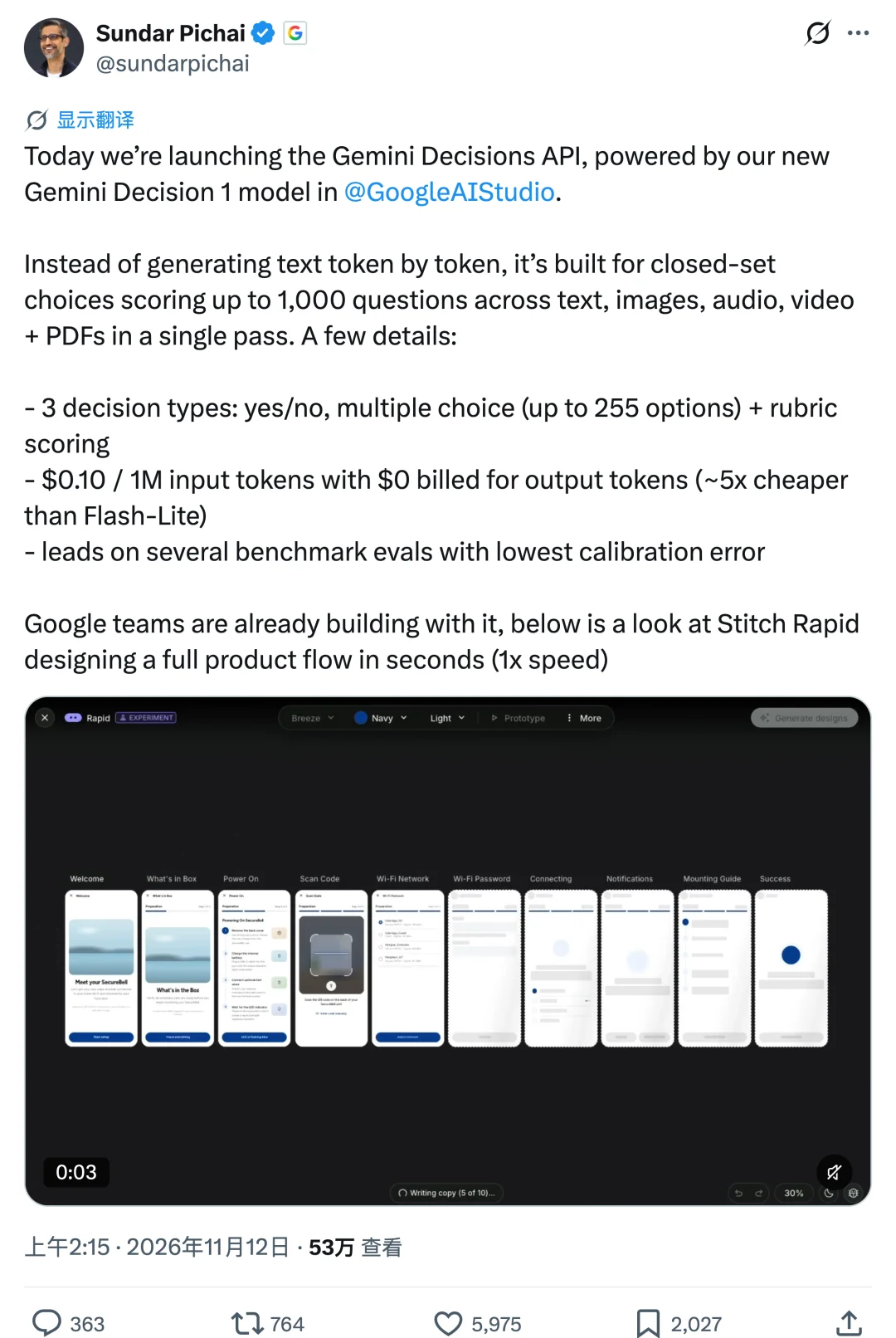
In the post he highlighted three details:
He also said Google's internal teams are already using it, and shared a 1x-speed demo of Stitch Rapid: a full product flow designed in seconds. For a real-world walkthrough, watch this hands-on video:
To have AI decide whether an email is spam, or which agent a task should go to, you usually call a generative model, wait for it to write out text, and then parse the result from that text. Decision 1 skips token-by-token decoding entirely. You give it the input, the questions and the candidate options, which Google calls closed-set choices. It scores all candidates in a single forward pass and returns the option it picked, along with a probability and a confidence score for each.
Tasks that only need a classification, a score or a selection no longer have to go through a full text generation.
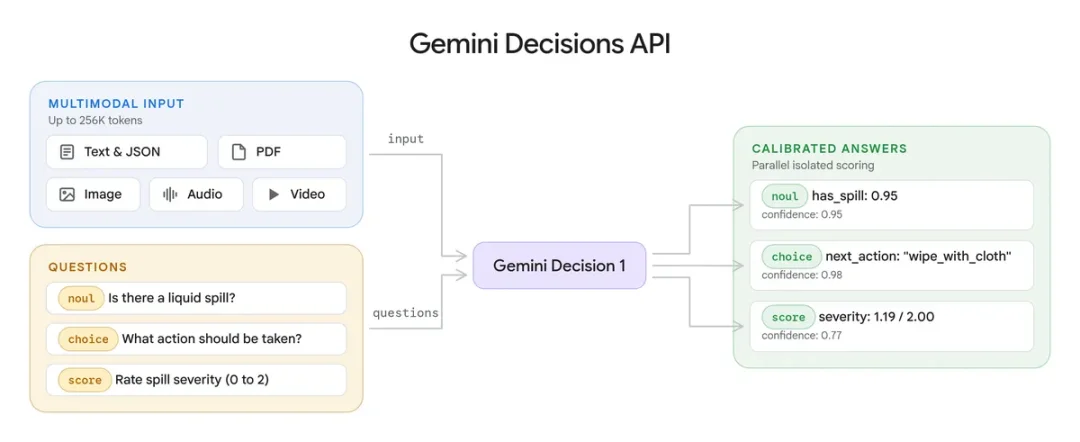
According to Google's numbers, one request can ask up to 1,000 independent questions. The input can be text, images, audio, video or PDFs, with end-to-end latency of 150 to 250 ms.
Pricing is aggressive too: $0.10 per million input tokens, with no output charge. On Google's shared benchmark suite, it is nearly 5 times cheaper than Gemini 3.5 Flash-Lite called through the Interactions API.
Google does not plan to limit it to multiple-choice questions. Model routing, agent tool selection, product design and safety detection are already in use inside Google, which positions it as the layer in an AI system that makes the call.
Decision 1 offers three question types:
| Type | Name in the API | What it does | Returns |
|---|---|---|---|
| Yes / no | noul | Whether a photo shows a safety hazard, or whether a text breaks a policy | Probability that the condition holds |
| Multiple choice | choice | Picks the best fit from 2 to 255 candidates | The winning option, and a normalized probability for each option |
| Ordered rubric | score | Grades against your scale, starting at 0 | A continuous weighted score, and a probability for each level |
The three types can be mixed in one request.
Google's example is a photo of an office breakroom counter with a short text note, asked three questions at once: is there an uncleaned liquid spill, what cleanup action fits, and how severe is the mess.
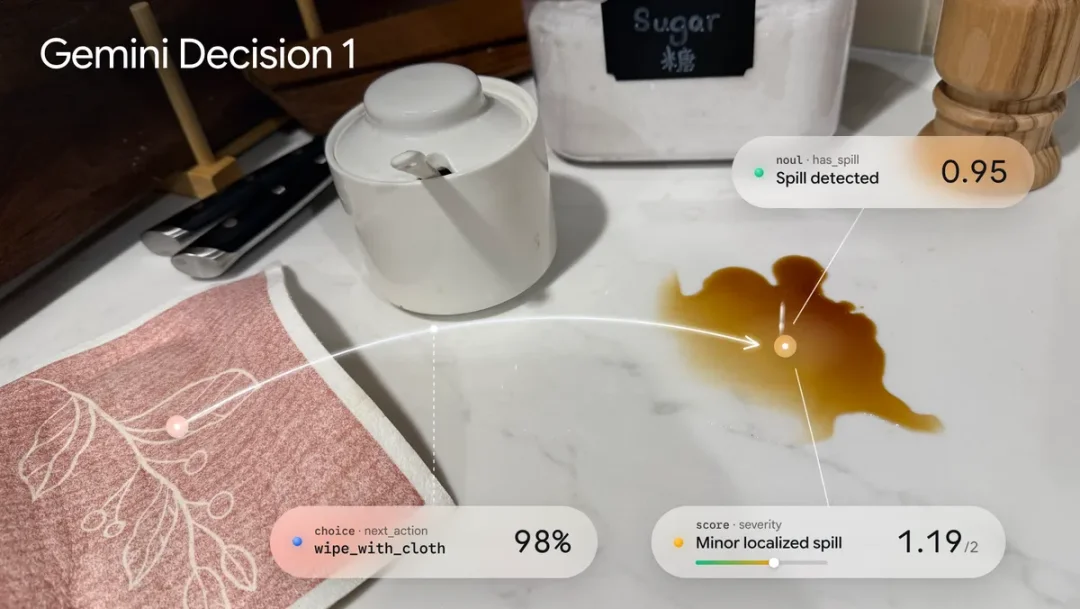
Before, this took several classifiers, or several prompts run separately against a generative model. Now it takes one request.
Input context goes up to 256K tokens, and modalities can be mixed. In an enterprise, that means judging a call recording together with account metadata, or reviewing an insurance claim file alongside damage photos.
Every answer carries a confidence score from 0 to 1. Uncertain cases can go to another model or a human reviewer.
Speed and cost are its other strengths. With context within 16K tokens, the median model compute latency is 50 to 100 ms, or 150 to 250 ms end-to-end. Going from 1 question to 100 in one request adds almost no latency. Shared input is billed once per request; each extra question adds only the tokens for its own instructions and options.
Google also published a scorecard worth a close look.
Usually a new model is compared against a group of general-purpose LLMs. This time Google chose three rivals from the same category: GPT-6 Luna on OpenAI's Decisions API, TypeSafe Jev 1.14, which is built for classification decisions, and its own Gemini 3.5 Flash-Lite.
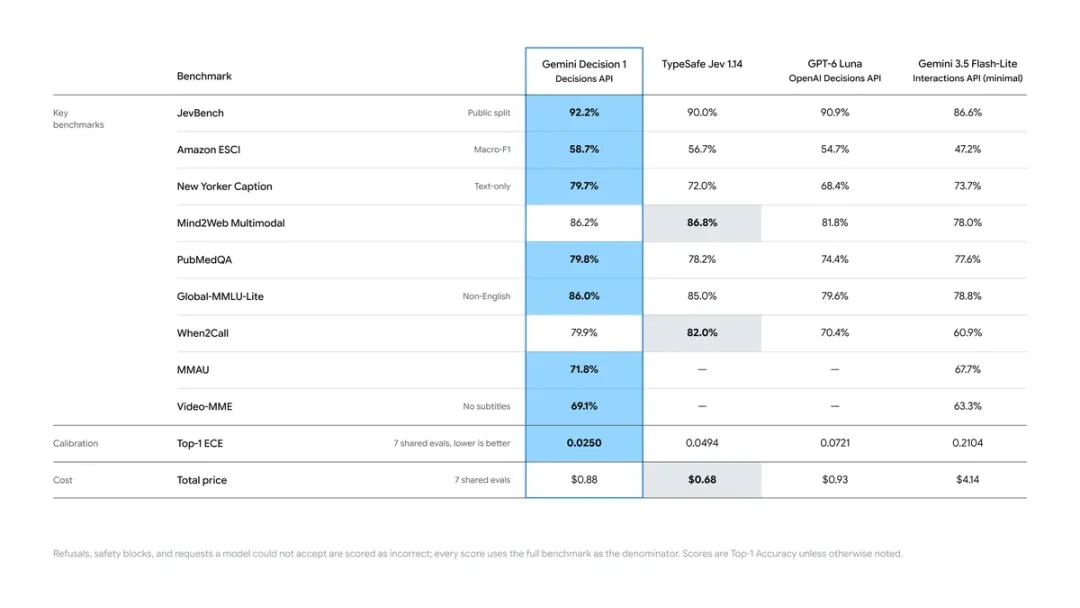
| Benchmark | Decision 1 | TypeSafe Jev 1.14 | GPT-6 Luna | Flash-Lite |
|---|---|---|---|---|
| JevBench | 92.2% | 90.0% | 90.9% | 86.6% |
| Amazon ESCI (Macro-F1) | 58.7% | 56.7% | 54.7% | 47.2% |
| New Yorker Caption | 79.7% | 72.0% | 68.4% | 73.7% |
| Mind2Web Multimodal | 86.2% | 86.8% | 81.8% | 78.0% |
| PubMedQA | 79.8% | 78.2% | 74.4% | 77.6% |
| Global-MMLU-Lite (non-English) | 86.0% | 85.0% | 79.6% | 78.8% |
| When2Call | 79.9% | 82.0% | 70.4% | 60.9% |
| MMAU (audio) | 71.8% | — | — | 67.7% |
| Video-MME (without subtitles) | 69.1% | — | — | 63.3% |
| Top-1 ECE (lower is better) | 0.0250 | 0.0494 | 0.0721 | 0.2104 |
| Total cost, 7 shared benchmarks | $0.88 | $0.68 | $0.93 | $4.14 |
Decision 1 came first on 7 of the 9 benchmarks and also had the lowest calibration error. On two of the nine benchmarks, and on total cost, a rival did better.
Start with the wins. On JevBench it scores 92.2%, 1.3 points above GPT-6 Luna. On Amazon ESCI, a product search relevance benchmark, it beats Luna by 4 points and Flash-Lite by 11.5 points.
The widest gap is on New Yorker Caption, which asks the model to pick the caption that fits a cartoon: reading context and choosing among candidates. Decision 1 scores 79.7% and Luna 68.4%, an 11.3-point gap. On PubMedQA, a medical question answering benchmark, it scores 79.8% against Luna's 74.4%. On the multilingual Global-MMLU-Lite it scores 86.0% against Luna's 79.6%.
Only Decision 1 and Flash-Lite have results on the audio benchmark MMAU and the video benchmark Video-MME. Decision 1 scores 71.8% and 69.1%, both above Flash-Lite.
On Mind2Web Multimodal, TypeSafe Jev leads with 86.8% and Decision 1 scores 86.2%, a 0.6-point gap.
On When2Call, Jev's lead is larger: 82.0% to 79.9%. The benchmark covers whether to call a tool and when to call it, which is exactly the agent scenario Google emphasizes, and Jev, built for decisions, still comes out ahead.
Total cost is not its lowest either. Across the 7 shared benchmarks, Decision 1 cost $0.88 and Jev cost $0.68. The "nearly 5 times cheaper" figure is measured against Flash-Lite's $4.14.
The footnote under the table counts refusals, safety blocks and requests the model could not handle as incorrect, and the denominator is the full test set.
Google put special emphasis on probability calibration. On Top-1 ECE (expected calibration error), Decision 1 scores 0.0250, Jev 0.0494, Luna 0.0721 and Flash-Lite 0.2104. By that math, its calibration error is about 65% lower than Luna's and about 88% lower than Flash-Lite's.
This metric matters most for agents. Say an agent checks a piece of code for security flaws. A model that answers yes or no and also gives a probability lets the system set a threshold: act automatically above it, and send anything below it to human review. If the model is right nine times out of ten when it says it is 90% sure, that threshold can be placed accurately. A poorly calibrated model makes it hard to place.
Many new models only publish benchmarks. Google also described four ways the Decisions API is used in its own products.
Gemini Notebook: real-time model routing. This is the most useful example. For each incoming request, the Decisions API first judges how complex it is, then picks a model tier and how much thinking to use. Everyday questions go to cheaper, faster models, and complex reasoning goes to strong models. Google says this cut latency on everyday queries by up to 40%.
This matches where agents are heading. An agent makes many small decisions as it works: which tool to use, which model to call, whether a person should review the result. If each simple decision goes to a large generative model, latency and cost keep piling up. A dedicated decision model splits the work: clear-cut judgments go to a low-latency model, and complex work stays with a general-purpose LLM.
Stitch: playable wireframes in seconds. The new Rapid Canvas experiment in Stitch uses the Decisions API to generate playable wireframes of a product flow in seconds, and applies edits made by voice or tap almost instantly. Once the direction is right, one click moves the screens into the full Stitch experience for further design work. The demo in Sundar Pichai's post shows this feature.
CC: picking an emoji from 200+ options. Google Labs' CC uses it to pick the right emoji reaction from more than 200 options in a fraction of a second, so reactions appear without adding latency.
Google Search: a safety layer for MCP tools. Search uses the Decisions API to add a safety layer to MCP tools, detecting adversarial behavior and content within the latency budget.
Get an API key in Google AI Studio to start. There is a free tier for prototyping. Google has three demo apps, Doorstep Parcels, Speed Sketch and Find the Zoo Keeper, and the docs include guides for Python, JavaScript and REST.
Beyond the google-genai SDK, integrations with OpenRouter, LangChain, Vercel, LiteLLM, Pydantic AI, Pipecat, LiveKit and OpenCode are rolling out, and support for Gemini in Google Cloud is coming.
All models are metered at official API prices. No surprise charges, cancel anytime.