Google takes first place back with Gemini 4 Carbon
Carbon's official benchmarks and third-party results, why the same price per token still means a pricier task, and the December 1 price increase.
Krypton burns 5.7x Carbon's thinking tokens to nail fine detail, while GPT-6.2 Sol in limited testing is rumored to tie for first place at $1.19 per task. Neither model is widely out yet, and testers who live in these models have already split up the work: one for depth, one for daily runs, and a third for code.
A comparison post has been making the rounds among developers: Google's Gemini 4 Krypton and OpenAI's GPT-6.2 Sol set side by side to see which one gets more done.
Look past the hype and the more interesting story is something else: people who spend all day testing models are already routing work by task. One model gets the deep, detail-heavy jobs, another handles everyday volume, and a third takes coding and orchestration. The wave of 2026 releases has largely killed the idea of one model for everything.
The short version: Krypton is willing to burn nearly 6x the thinking tokens to obsess over detail, while GPT-6.2 Sol is pitched as tying for first place at roughly a tenth of the bill. Neither model has officially launched, though, and the circulating Sol benchmark isn't on the Artificial Analysis website. The models you can actually put to work today are Carbon, Argon, GPT-6.1 Sol and Opus 5.5 — see the real-world numbers below for how to pick one for each job.
Start with Gemini 4 Krypton. What made it go viral is creative work: give it a single prompt and it builds a complete voxel world — harbor, lighthouse, cherry blossom trees, castle and sailboats included, right down to the water and lighting.
Clips from Krypton (a very early checkpoint), Carbon and Argon have been put side by side, each a little over forty seconds long, generating the same voxel harbor town. You can spot the difference in detail density at a glance.
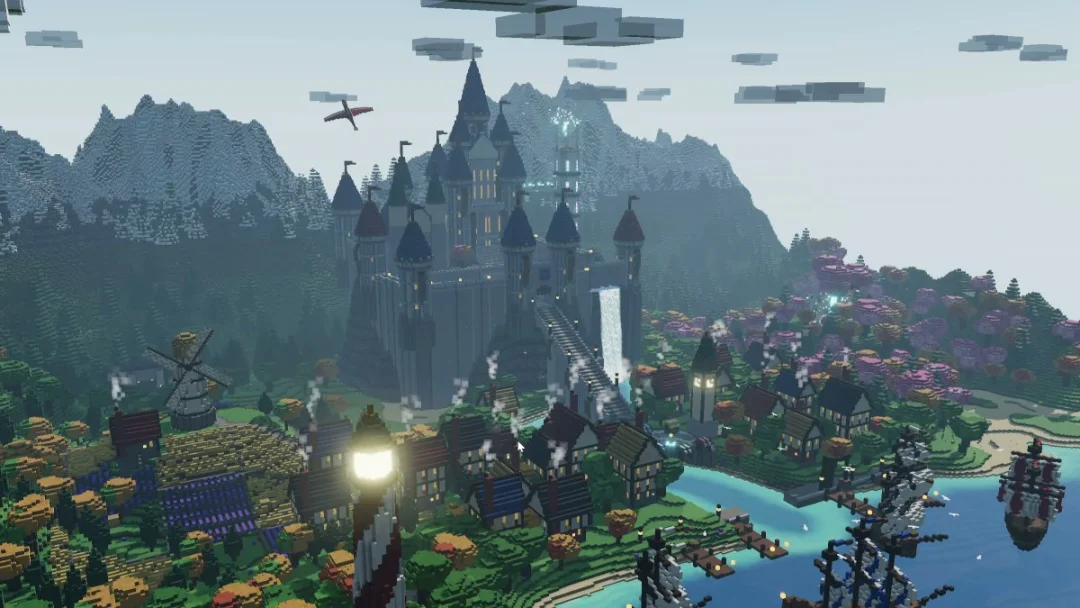 X · @lyraxanaGemini 4 Krypton vs Carbon vs ArgonWatch on X
How does it get that level of detail? By burning thinking tokens. It works slowly and deliberately before writing a line of output, refusing to cut corners even on the PlayStation logo in the middle of an SVG controller.
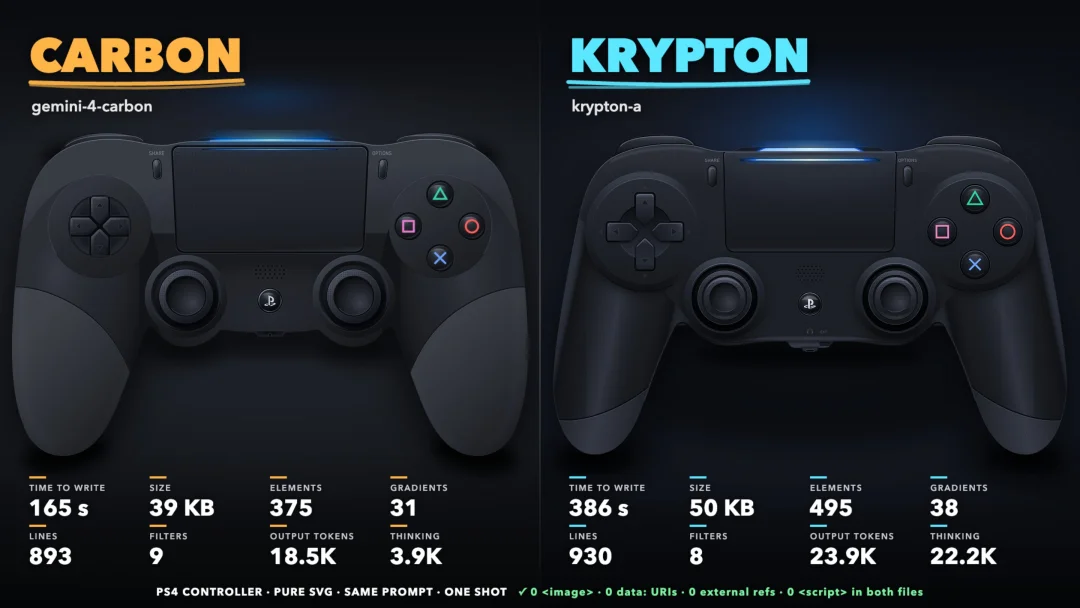
On the same prompt, Krypton takes more than twice as long, and in return you get the most detailed output Google has produced so far — just look at the details of the PS logo in the center of the controller.
| Metric | Gemini 4 Carbon | Krypton | Krypton / Carbon |
|---|---|---|---|
| Time to write | 165s | 386s | 2.3× |
| Thinking tokens | 3.9K | 22.2K | 5.7× |
| Output tokens | 18.5K | 23.9K | 1.3× |
| File size | 39 KB | 50 KB | 1.3× |
| Lines of code | 893 | 930 | 1.04× |
It took more than double the time, yet the final SVG is only 4% more lines of code. Almost all the extra work went into thinking tokens — 5.7 times as many as Carbon. Every curve and shadow was worked out before writing, not padded out with extra lines of code.
Trading thinking tokens for detail runs through the whole Gemini 4 family. Krypton's PS5 controller SVG follows the same pattern, and Google AI Studio lead Logan Kilpatrick put it this way: "Carbon is a great model, but the team is still cooking : )"
The cost is just as blunt. Running Gemini 4 Carbon at high reasoning effort for around 7 hours across multiple projects in parallel in Google's Antigravity took one developer's weekly limit from about 88% down to 23% — burning through more than 60% of the quota in a single stretch.
The higher you turn up reasoning effort, the better the output, the longer the wait, and the more tokens land on the bill. That pattern shows up again and again across the models below.
Now look at GPT-6.2 Sol. The image circulating hardest in the community over the past few days is a screenshot claiming to show first-wave results from Artificial Analysis (AA):
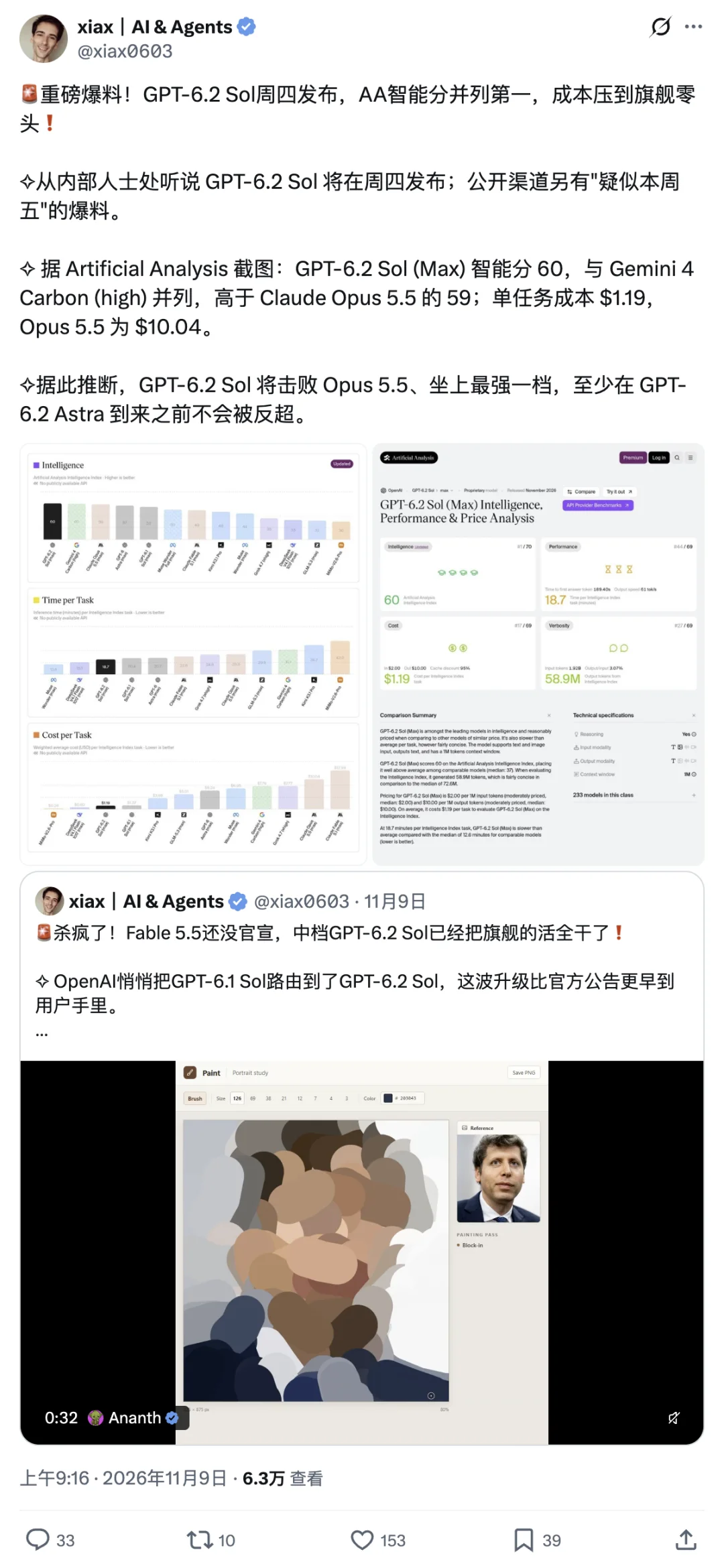
According to the numbers in the screenshot, Sol hits 60 on the Intelligence Index — tying Google's Gemini 4 Carbon for first place, edging out Claude Opus 5.5 (59), jumping a full 5 points over GPT-6.1 Sol, and even passing OpenAI's own GPT-6 Astra to become the first OpenAI model to beat Opus 5.5 outright.
The speed and cost numbers look even wilder: average time per complex task drops to 18.7 minutes, and cost per task comes in at $1.19 — about one-eighth of Opus 5.5 ($10.04).
Hold off on taking that as settled fact, though. We checked the Artificial Analysis site and OpenAI's documentation, and as of November 12, GPT-6.2 Sol is nowhere on the AA leaderboard, and the model page URL in the screenshot returns a 404. Putting the rumored numbers next to the flagship models actually live on AA tells a clearer story:
| AA metric | GPT-6.2 Sol (circulating screenshot) | GPT-6.1 Sol (max) | Claude Opus 5.5 (max) | Gemini 4 Carbon (high) |
|---|---|---|---|---|
| Intelligence Index | 60 | 55 | 59 | 60 |
| Time per task | 18.7 min | 21.9 min | 25.0 min | 25.7 min |
| Cost per task | $1.19 | $1.27 | $10.04 | $7.76 |
| Output tokens from Intelligence Index | 58.9M | 63.7M | 218M | 205M |
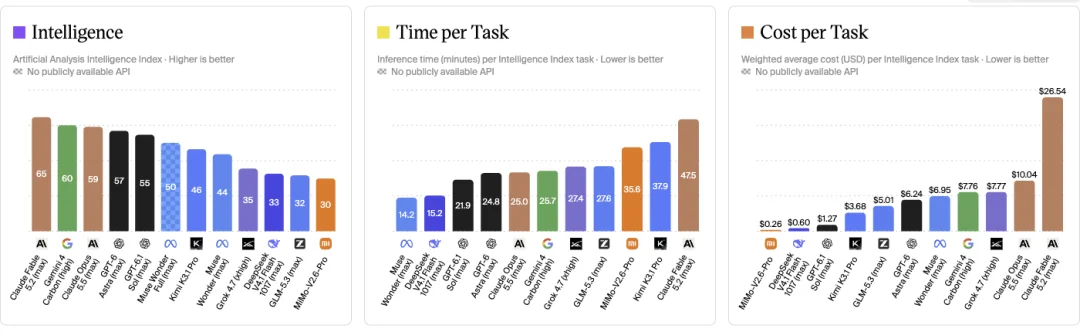
Start with task time. The rumored 18.7 minutes is roughly a quarter faster than both Opus 5.5 (25.0 minutes) and Carbon (25.7 minutes), making it the briskest of these flagships. One caveat matters, though: AA's median for comparable models is 12.8 minutes, so it's fast for a heavyweight flagship, not fast overall.
What really lit up the community is the $1.19 cost per task — roughly one-eighth of Opus 5.5 and one-fifth of GPT-6 Astra ($6.24). Compare that with the live data above, though, and one thing jumps out: low task cost isn't new to 6.2. GPT-6.1 Sol, which is already live, costs $1.27 per task — just 8 cents more than the rumored $1.19. We think if you want a low-cost daily driver right now, 6.1 Sol already fits the bill without waiting for 6.2.
Sol's per-token sticker price isn't unusual: GPT-6.1 Sol is $2 per million input tokens and $10 per million output tokens with a 1M token context window, right in line with peers. What keeps the bill down is brevity: across the full Intelligence Index run, 6.1 Sol produced 63.7 million output tokens, while Opus 5.5 and Carbon both topped 200 million. Because it writes much leaner answers, the cost per task stays low.
Watch out for one billing trap here: both OpenAI and Google bill thinking tokens at the output token rate. Leave reasoning uncapped and a single call can easily cost several times what a normal Q&A turn would.
Demos have been flooding timelines too. From a single prompt, accounts routed to the new Sol can spit out a complete Three.js 3D scene packed into a single HTML file — no Blender, no external assets — rendering black holes, sailboats and colosseums that spin right in the browser, pitted head-to-head against Opus 5.5 on the same prompts. One tester ran it for 3 hours straight building Three.js demos and found it better than Opus 5.5.
What regular users care about most is the subscription math. For Plus subscribers, Sol could be the biggest and best upgrade Plus users have ever received: it outperforms Opus 5.5 in everyday use without burning through usage limits too quickly, even within the 5-hour window, so OpenAI's $20 plan is finally starting to make sense again.
Most of those claims, though, come from accounts that track leaks and pre-release signals, and they're written in the future tense. It sounds great on paper, but until the model officially ships, we think it's worth keeping a question mark on it.
To check whether your account has been quietly routed to the new model, the community has a quick test: pick GPT-6.1 Sol (set to Max or xhigh), turn off web search and memory, and ask "do you know Claude Fable 5" — if it knows, you're in the rollout. Testers who have it also point out a welcome change in tone: instead of hedging every sentence to cover itself first, its replies are much more direct.
The release timeline has had plenty of head-fakes too. On November 9, the OpenAI Developers account posted a 14-second clip that said just one word — "Tomorrow." — racking up more than 2.4 million views and convincing most of the timeline that the new model was dropping the next day:
 X · @OpenAIDevsTomorrow.Watch on X
The next day revealed the punchline: it wasn't a model at all, but a Game Boy-style retro handheld added to OpenAI's merch store (the ModRetro Chromatic).
As for the rumor that GPT-6.2 Sol would launch on Thursday, November 12 came and went with no sign of it in OpenAI's official model documentation.
All of this is still small-scale testing during a limited rollout, and the benchmark screenshot has no verified source. Once it ships widely and Artificial Analysis runs its own evaluation, it'll be worth another look.
Beyond Krypton, the two Google models developers compare most in this generation are Carbon and Argon — and they have very different temperaments.
| Metric | Gemini 4 Carbon (high) | Gemini 4 Argon (high) | Source |
|---|---|---|---|
| Intelligence Index | 60 | 50 | AA |
| Output speed | 80 tok/s | 65 tok/s | AA |
| Time to first answer token | 67s | 37s | AA |
| Time per task | 25.7 min | 30.0 min | AA |
| Hallucination rate | 11% | 4% | AA-Omniscience |
| Vibe Code Bench | 89.06% | 91.91% | Vals AI (OpenHands) |
| Context window | 1M tokens | 1M tokens | |
| Input / output per 1M tokens | $2 / $10 ($4 / $20 from Dec 1) | $2 / $10 ($4 / $20 from Dec 1) | Google pricing page |
Carbon scores 60 on the Intelligence Index with a 1M token context window; long documents, cybersecurity and long-running autonomous tasks are its home turf. Its weak spots stand out just as clearly: an 11% hallucination rate at high reasoning effort, and more than a minute of waiting for the first answer token.
Argon sits a tier lower on raw score — 50 on the Intelligence Index — but wins on steadiness: it keeps its hallucination rate down to 4%, scores 91.91% on Vals AI's Vibe Code Bench (ahead of both Carbon at 89.06% and Opus 5.5 at 90.29%), and cuts time to first answer token to around 37 seconds.
Note the catch, though: Argon only starts answering faster. Over a full task, it actually finishes slower — averaging 30.0 minutes per task on AA, more than four minutes longer than Carbon (25.7 minutes).
Both carry an introductory price of $2 per million input tokens and $10 per million output tokens through November 30, doubling to $4 and $20 starting December 1. Carbon launched to a small group of cyber defenders and opened its API to all paying developers on November 10, while neither model is available on the Free tier.
Speed is also the number-one complaint about Carbon right now. When Theo (t3.gg) timed the same coding task across models, Opus 5.5 on high finished in 9m 33s, while Carbon on its lowest setting (low) dragged on for 22m 21s.
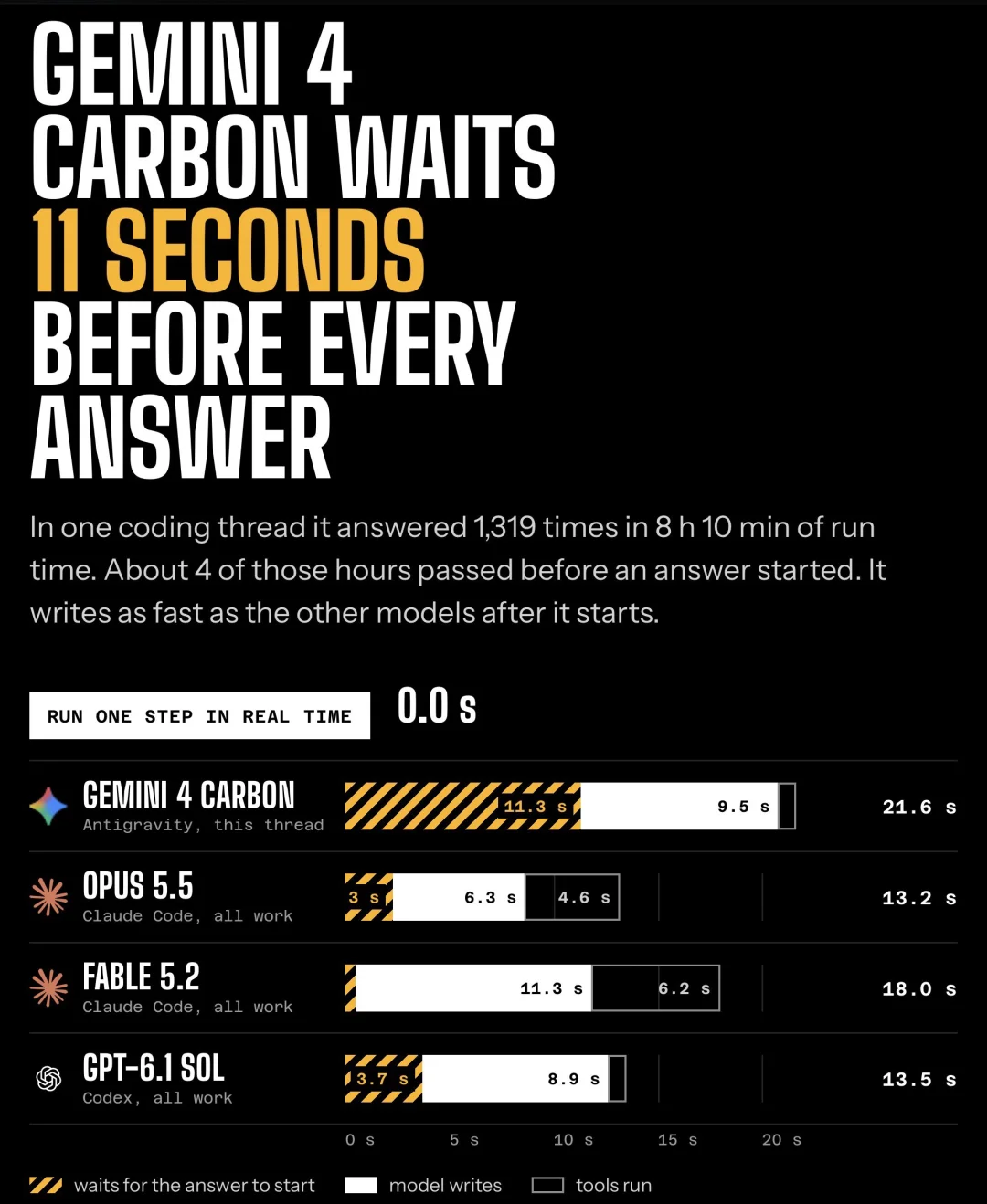
Break down a single step and you see where the time goes: Carbon waits more than 11 seconds before it starts to respond, and once it starts, it writes as fast as the other models. Across an 8-hour, 10-minute session where it answered 1,319 times, about 4 of those hours passed just waiting for an answer to start. Almost all of it is server-side on Google's end, not the model itself.
Tight usage limits add to the frustration. Even on Google's top $200-a-month plan, the quota allotted to full Gemini 4 models is tiny and runs out fast. The tech is ahead, but the consumer offering hasn't caught up.
One set of numbers from AA's Intelligence Index is worth lining up on its own: across the full benchmark suite, Carbon produced 205M output tokens, Argon 113M, and GPT-6.1 Sol 63.7M. Same per-token price table, very different task bills: by AA's math, Argon comes out to $9.95 per task, Carbon $7.76, and GPT-6.1 Sol $1.27. The gap comes down to how much each model writes and how long it thinks — the same thinking-token math from earlier showing up again.
When reading the leaderboards, watch the tag in parentheses after each model name: AA tested Carbon and Argon at (high), while Opus 5.5 and Sol were tested at (max). Reasoning effort settings and agent harnesses aren't uniform across vendors, so a one- or two-point gap on a chart isn't a hard verdict.
Match the tool to the work, and the split testers have settled on is straightforward:
No single model wins across every column. Even if GPT-6.2 Sol matches Carbon's score as rumored, its time per task is still slower than the median for comparable models; Carbon is strong on long-horizon work, but you pay for it in long waits and a higher hallucination rate; Argon is steady, at the cost of a lower ceiling on hard reasoning. As for Opus 5.5, both its per-token rates and its cost per task are far higher than Sol's, and on AA its time to first answer token is nearly 6 minutes — expensive and slow, yet still the most trusted hand for writing code. A one- or two-point gap on a leaderboard feels completely different once you put it on your own workload.
Krypton and GPT-6.2 Sol aren't widely out yet, but you can run that exact task split today with the four models that are already live. On CodingPass, all of them share one API key, and switching models is just changing the model ID (see All models for monthly allowances on each plan):
| Model | Model ID | Available now? | Minimum CodingPass plan |
|---|---|---|---|
| Gemini 4 Krypton | — | Internal testing at Google | — |
| GPT-6.2 Sol | — | Limited testing on select accounts, unreleased | — |
| Gemini 4 Argon | gemini-4-argon | Live | Go |
| Gemini 4 Carbon | gemini-4-carbon | Live | Go |
| GPT-6.1 Sol | gpt-6.1-sol | Live | Plus |
| Claude Opus 5.5 | claude-opus-5-5 | Live | Plus |
When picking a model for your own work, decide first whether the job is about obsessing over detail or chewing through volume, and set the reasoning effort from there — that matters far more than chasing a one- or two-point lead on a leaderboard. Turn reasoning effort up for creative work and let it take its time; dial it down for everyday Q&A so you aren't burning a long chain of internal monologue on a quick question. Both your bill and your wait time usually come down to that one switch.
The 2026 wave of releases has put the choice of tool back in the user's hands. Rather than waiting around for one model to rule them all, split up the work in front of you and send each job to the model that fits it best. When good tools are everywhere, knowing how to pick beats waiting around.
Switch models with one key, metered at official API prices. No surprise charges, cancel anytime.