All models
Every model's ID, minimum plan and monthly allowance on Go, Plus and Pro.
Tencent distilled Hy4 flash from Hy4, cutting input and output API prices to 1/12 and 1/9 and bringing office tasks like slides, docs, and spreadsheets down to around CNY 0.2 per task. Coding benchmarks in the appendix drop sharply, leaving Hy4 as the pick for long-horizon software engineering. Here are the full benchmarks, blind evaluation, traffic-mix bills, and self-hosting requirements.
On November 16, Tencent released Hy4 flash, calling it "our most cost-effective Hy model to date." It is a lighter sibling to Hy4 with 224B total parameters (including 64B Engram parameters) and 12B active parameters per token. It natively accepts text and image inputs, supports a 1M token context window, and ships with open weights alongside API pricing of CNY 0.5 per million input tokens, CNY 2 per million output tokens, and CNY 0.02 per million for cache hits.
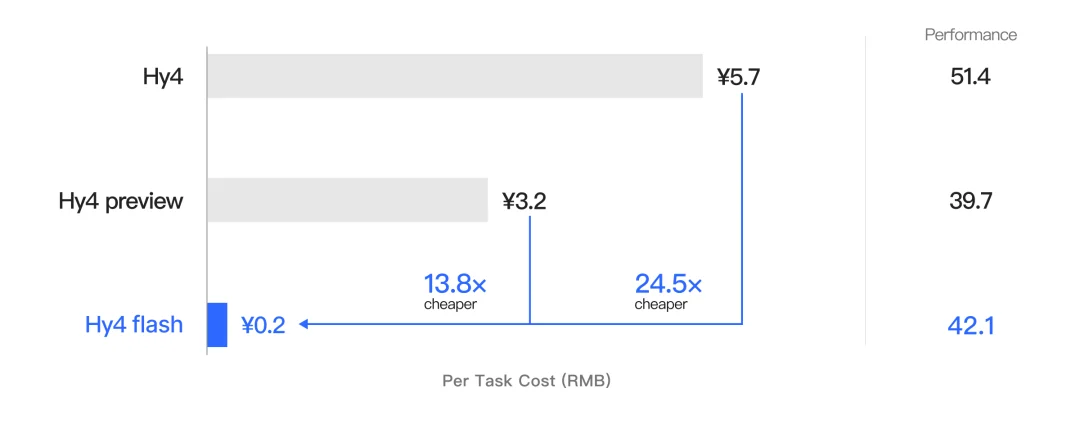
Instead of leading with public leaderboards, Tencent centered the launch on WorkIndex, its internal office-task suite. On slides, documents, and spreadsheets, Hy4 flash scores 42.1—slightly ahead of Hy4 preview (39.7)—at CNY 0.2 per task, compared with CNY 5.7 for Hy4.
Bottom line: For everyday agent tasks like documents, slide decks, search, and simple web pages, Hy4 flash has the lowest per-token price of the models it was compared against. Modeled on CodingPass's production traffic mix, a single request costs about CNY 0.0064—roughly 1/12 of Hy4 and 3/10 of DeepSeek-V4.1-Flash at peak hours. Keep it away from serious coding: in the appendix, Terminal-Bench 4.0 drops to 19.2 (vs. 44.4 for Hy4 and 40.0 for DeepSeek-V4.1-Flash) and ProgramBench falls to 16.0 (vs. 30.0 for Hy4). Tencent itself recommends Hy4 for long-horizon software engineering.
Cost reduction starts in the model architecture. Hy4 flash combines hybrid attention, LatentMoE, and Engram, cutting KV cache size to 1/24 of Hy3 and 1/6 of Hy4. Tencent says those design choices were validated through extensive scaling ladder experiments prior to pre-training.
Post-training runs in two stages: self-distillation from Hy4 to establish general capability, followed by reinforcement learning that cuts average end-to-end output tokens by 50%. On the serving side, megakernels, 4-bit quantization, and the built-in DFly speculative decoding drafter push decoding speed past 150 tokens/s, according to Tencent.
The official GitHub README breaks down the exact specs:
| Spec | Hy4 flash |
|---|---|
| Total parameters | Backbone 155.5B + Engram 63.5B + Vision Encoder 0.43B + DFly2 0.85B (~220B total) |
| Active per token | Text 11.3B + Vision 0.43B |
| Layers | 42 layers: 1 dense + 41 MoE |
| Experts | 512 routed experts per layer, 16 active per token, plus 1 shared expert; routed experts operate in a low-dimensional latent space (LatentMoE) |
| Attention | Sparse attention (IndexPool, selecting up to 2,048 positions) and sliding-window attention (512-token window) interleaved at 1:3 |
| Engram | Multi-head hash lookups for bigram and trigram representations, attached at layers 1, 11, 21, and 31 (0-indexed) |
| Vision encoder | Adapted from SigLIP2-So400m, connected to the backbone via an MLP projector |
| Speculative decoding | Built-in 5-layer drafter DFly2; reuses the main model's KV cache and sparse attention indices with zero extra KV memory |
| Context window | 1,048,576 tokens |
The launch blog lists 224B total, 64B Engram, and 12B active parameters, whereas summing the README components yields 220B, 63.5B, and 11.7B. Tencent has not explained the discrepancy.
Hy4 flash is live on Tencent Cloud TokenHub, WorkBuddy, Yuanbao, WeCom, QQ, ima, and Marvis, with OpenRouter support coming.
| Model (CNY / 1M tokens) | Input (cache hit) | Input | Output |
|---|---|---|---|
| Hy4 flash | 0.02 | 0.5 | 2 |
| Hy4 | 0.3 | 6 | 18 |
| DeepSeek-V4.1-Flash (peak hours) | 0.04 | 2 | 8 |
| DeepSeek-V4.1-Flash (off-peak) | 0.02 | 1 | 4 |
| GLM-5.3-Flash | 0.23 | 0.8 | 2.8 |
Compared with Hy4, Hy4 flash cuts input pricing to 1/12, output to 1/9, and cache hits to 1/15. Through November 30, Tencent Cloud TokenHub is discounting the API by 50%, and WorkBuddy access is free for a limited time.
For DeepSeek-V4.1-Flash, Tencent's comparisons use peak-hour rates (01:00–04:00 and 06:00–10:00 UTC, Monday–Friday). According to the DeepSeek pricing page, off-peak rates are half of the peak rates: cache hits drop to CNY 0.02—matching Hy4 flash—while standard input and output remain 2x higher. GLM-5.3-Flash rates come from the Zhipu pricing page.
To see how those list prices translate into production spend, we modeled a typical CodingPass agent request: roughly 100K tokens total, split 5% fresh input, 1% output, and 94% cache reads.
Cost per request = 5K × input + 94K × cache hit + 1K × outputHy4 flash = 0.0025 + 0.00188 + 0.002 = CNY 0.00638| Model | Per request (CNY) | 10K req/mo (CNY) | 100K req/mo (CNY) | 1M req/mo (CNY) |
|---|---|---|---|---|
| Hy4 flash | 0.0064 | 64 | 638 | 6,380 |
| DeepSeek-V4.1-Flash (off-peak) | 0.0109 | 109 | 1,088 | 10,880 |
| DeepSeek-V4.1-Flash (peak) | 0.0218 | 218 | 2,176 | 21,760 |
| GLM-5.3-Flash | 0.0284 | 284 | 2,842 | 28,420 |
| Hy4 | 0.0762 | 762 | 7,620 | 76,200 |
Because cache reads make up over 90% of agent token volume, cache pricing drives the bill. GLM-5.3-Flash looks inexpensive on fresh input and output, but its CNY 0.23 cache hit rate is 11.5x Hy4 flash's—making it more expensive than peak-hour DeepSeek in this workload.
The table assumes identical token counts across models. If Hy4 flash's 50% reduction in end-to-end output tokens holds in your pipeline, its savings widen further; conversely, if it misses on the first pass and forces retries, real cost scales as cost per run ÷ first-pass success rate.
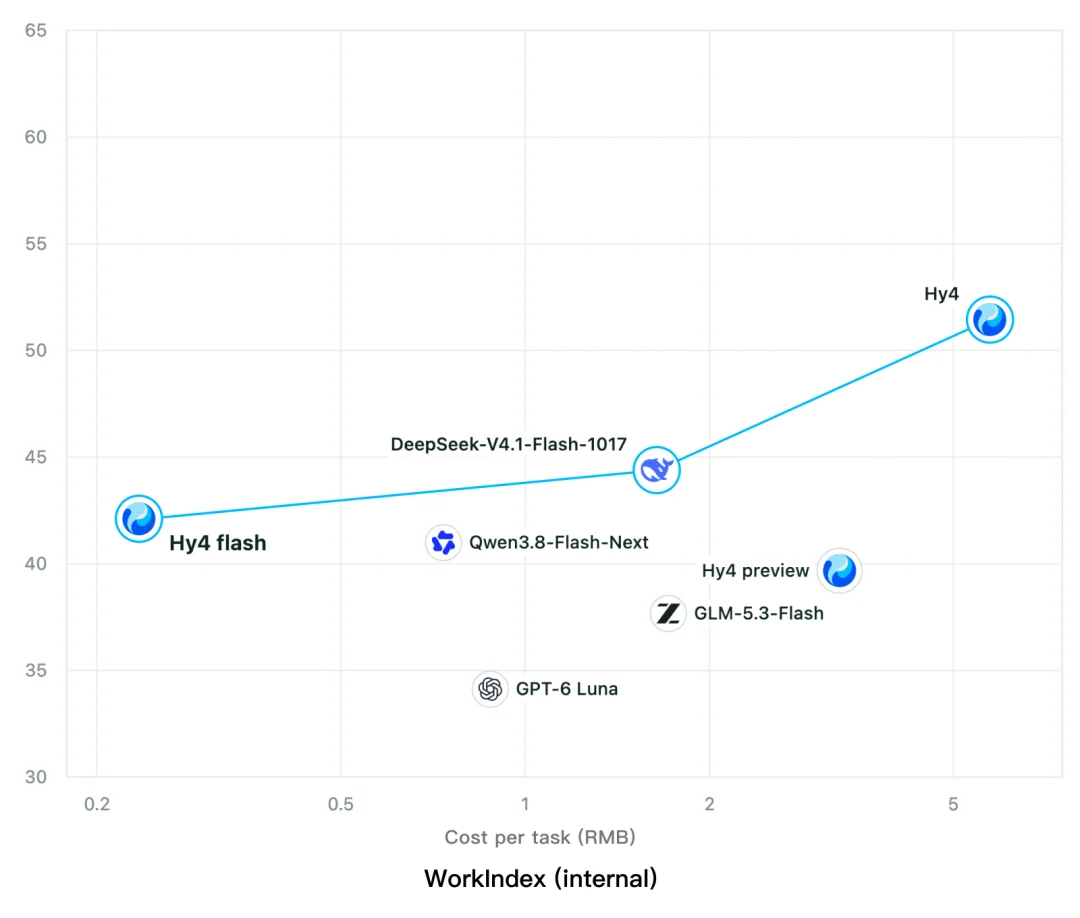
Tencent published two evaluation suites. The first is WorkIndex (internal), built from typical WorkBuddy tasks and paired with human evaluation of deliverable quality, single-turn output length, and task turnaround time across eight sets: slide creation, slide editing, human-AI slide co-writing, Markdown human-AI co-writing, document editing, spreadsheet repair, audio/video processing, and visual understanding. The second groups seven public agent benchmarks: DeepSWE, ProgramBench, Terminal-Bench 4.0, APEX-Agents, AutomationBench, HLE, and OSWorld 2.1. Both charts plot score against cost per task (RMB, log scale). On WorkIndex, Hy4 flash sits at the far left, trailing DeepSeek-V4.1-Flash by about 2 points:
On the seven public agent benchmarks, the score gap widens:
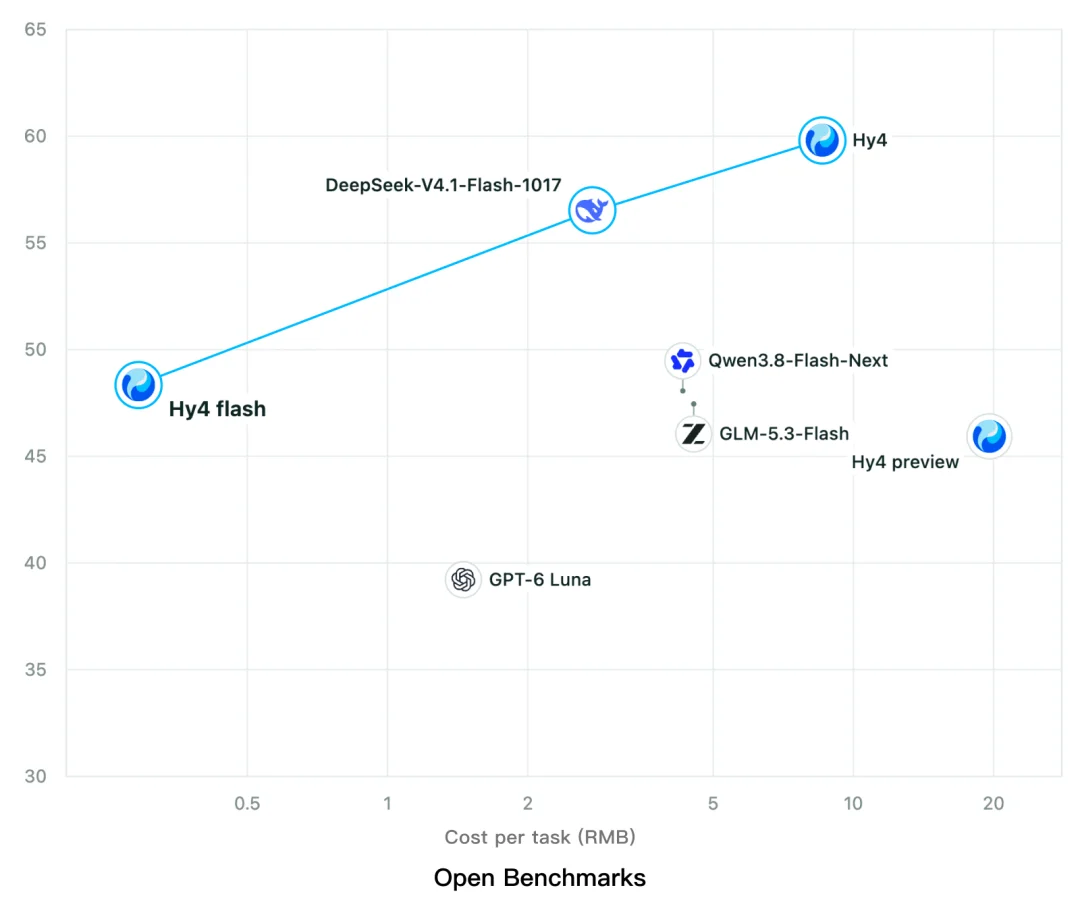
Here, Hy4 flash matches Qwen3.8-Flash-Next and GLM-5.3-Flash on score while cutting cost per task by an order of magnitude, though it trails DeepSeek-V4.1-Flash by roughly 8 points.
Tencent's headline claim rests on WorkIndex: Hy4 flash edges out Hy4 preview on overall task quality while cutting average cost per task to 1/13 of Hy4 preview, 1/20 of Hy4, and 1/8 of DeepSeek-V4.1-Flash-1017 (Max tier, peak-hour pricing).
The appendix breaks down every benchmark score and per-task cost:
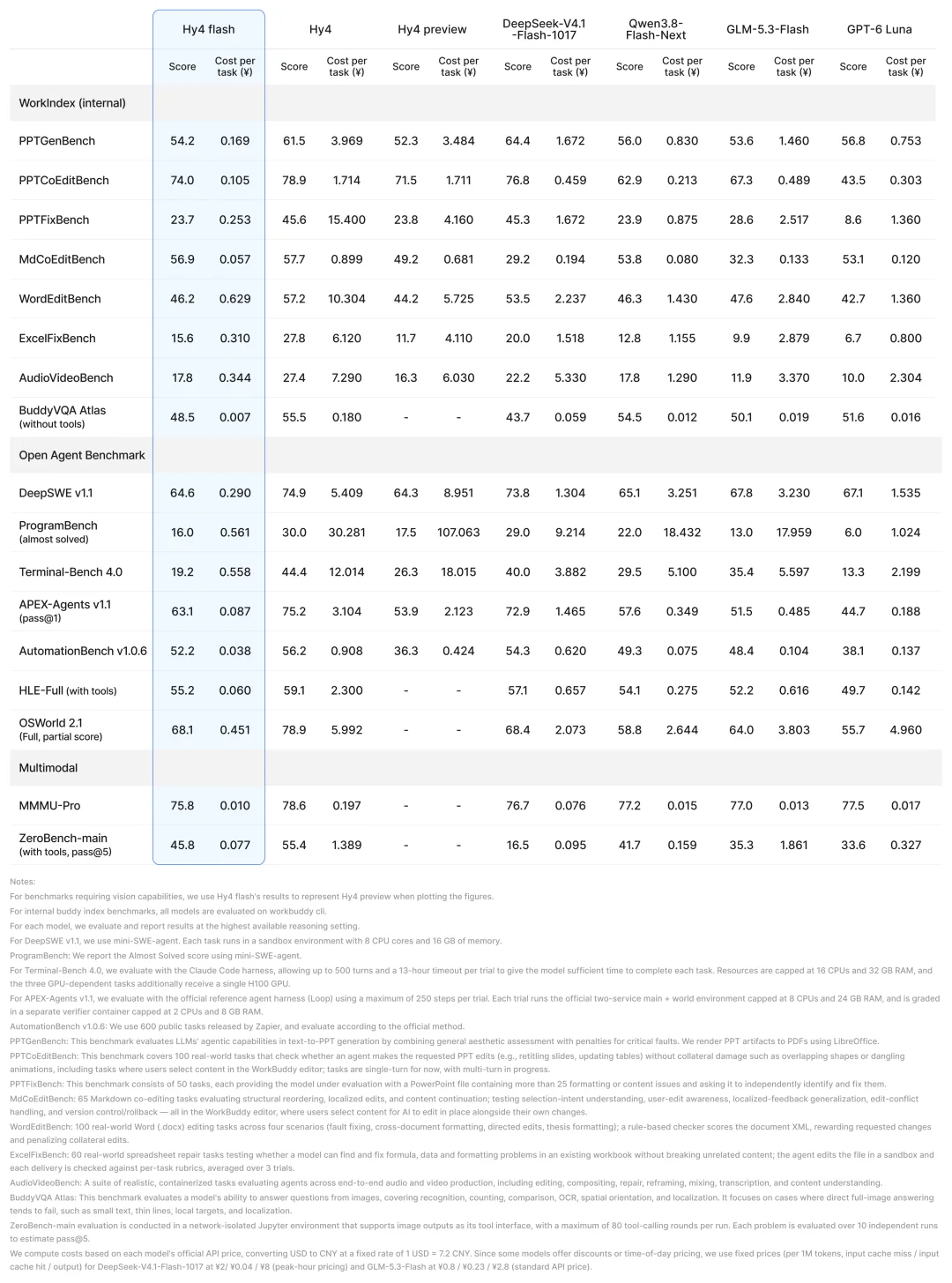
Below are all 17 rows split into three tables. Numbers in parentheses are cost per task in CNY; bold marks the highest score among the five Flash-tier models (Hy4 flash, DeepSeek-V4.1-Flash, Qwen3.8-Flash-Next, GLM-5.3-Flash, and GPT-6 Luna):
| WorkIndex (internal, 8 tasks) | Hy4 flash | Hy4 | Hy4 preview | DeepSeek-V4.1-Flash | Qwen3.8-Flash-Next | GLM-5.3-Flash | GPT-6 Luna |
|---|---|---|---|---|---|---|---|
| PPTGenBench | 54.2 (0.169) | 61.5 (3.969) | 52.3 (3.484) | 64.4 (1.672) | 56.0 (0.830) | 53.6 (1.460) | 56.8 (0.753) |
| PPTCoEditBench | 74.0 (0.105) | 78.9 (1.714) | 71.5 (1.711) | 76.8 (0.459) | 62.9 (0.213) | 67.3 (0.489) | 43.5 (0.303) |
| PPTFixBench | 23.7 (0.253) | 45.6 (15.400) | 23.8 (4.160) | 45.3 (1.672) | 23.9 (0.875) | 28.6 (2.517) | 8.6 (1.360) |
| MdCoEditBench | 56.9 (0.057) | 57.7 (0.899) | 49.2 (0.681) | 29.2 (0.194) | 53.8 (0.080) | 32.3 (0.133) | 53.1 (0.120) |
| WordEditBench | 46.2 (0.629) | 57.2 (10.304) | 44.2 (5.725) | 53.5 (2.237) | 46.3 (1.430) | 47.6 (2.840) | 42.7 (1.360) |
| ExcelFixBench | 15.6 (0.310) | 27.8 (6.120) | 11.7 (4.110) | 20.0 (1.518) | 12.8 (1.155) | 9.9 (2.879) | 6.7 (0.800) |
| AudioVideoBench | 17.8 (0.344) | 27.4 (7.290) | 16.3 (6.030) | 22.2 (5.330) | 17.8 (1.290) | 11.9 (3.370) | 10.0 (2.304) |
| BuddyVQA Atlas (no tools) | 48.5 (0.007) | 55.5 (0.180) | — | 43.7 (0.059) | 54.5 (0.012) | 50.1 (0.019) | 51.6 (0.016) |
| Public agent benchmarks (7 tasks) | Hy4 flash | Hy4 | Hy4 preview | DeepSeek-V4.1-Flash | Qwen3.8-Flash-Next | GLM-5.3-Flash | GPT-6 Luna |
|---|---|---|---|---|---|---|---|
| DeepSWE v1.1 | 64.6 (0.290) | 74.9 (5.409) | 64.3 (8.951) | 73.8 (1.304) | 65.1 (3.251) | 67.8 (3.230) | 67.1 (1.535) |
| ProgramBench (almost solved) | 16.0 (0.561) | 30.0 (30.281) | 17.5 (107.063) | 29.0 (9.214) | 22.0 (18.432) | 13.0 (17.959) | 6.0 (1.024) |
| Terminal-Bench 4.0 | 19.2 (0.558) | 44.4 (12.014) | 26.3 (18.015) | 40.0 (3.882) | 29.5 (5.100) | 35.4 (5.597) | 13.3 (2.199) |
| APEX-Agents v1.1 (pass@1) | 63.1 (0.087) | 75.2 (3.104) | 53.9 (2.123) | 72.9 (1.465) | 57.6 (0.349) | 51.5 (0.485) | 44.7 (0.188) |
| AutomationBench v1.0.6 | 52.2 (0.038) | 56.2 (0.908) | 36.3 (0.424) | 54.3 (0.620) | 49.3 (0.075) | 48.4 (0.104) | 38.1 (0.137) |
| HLE-Full (with tools) | 55.2 (0.060) | 59.1 (2.300) | — | 57.1 (0.657) | 54.1 (0.275) | 52.2 (0.616) | 49.7 (0.142) |
| OSWorld 2.1 (Full, partial score) | 68.1 (0.451) | 78.9 (5.992) | — | 68.4 (2.073) | 58.8 (2.644) | 64.0 (3.803) | 55.7 (4.960) |
| Multimodal (2 tasks) | Hy4 flash | Hy4 | Hy4 preview | DeepSeek-V4.1-Flash | Qwen3.8-Flash-Next | GLM-5.3-Flash | GPT-6 Luna |
|---|---|---|---|---|---|---|---|
| MMMU-Pro | 75.8 (0.010) | 78.6 (0.197) | — | 76.7 (0.076) | 77.2 (0.015) | 77.0 (0.013) | 77.5 (0.017) |
| ZeroBench-main (with tools, pass@5) | 45.8 (0.077) | 55.4 (1.389) | — | 16.5 (0.095) | 41.7 (0.159) | 35.3 (1.861) | 33.6 (0.327) |
Two patterns hold across all 17 benchmarks:
Appendix footnotes spell out the test harness: every model ran at its highest available reasoning effort; all internal benchmarks ran inside WorkBuddy CLI; DeepSWE and ProgramBench used mini-SWE-agent; Terminal-Bench 4.0 ran on Claude Code with a cap of 500 turns and 13 hours per task; and costs reflect official API rates converted at 7.2 RMB per USD.
Tencent also ran a blind evaluation with 85 internal WorkBuddy users across 259 daily work tasks spanning 27 categories, setting external models (DeepSeek, Claude Haiku, GLM) to high reasoning effort.
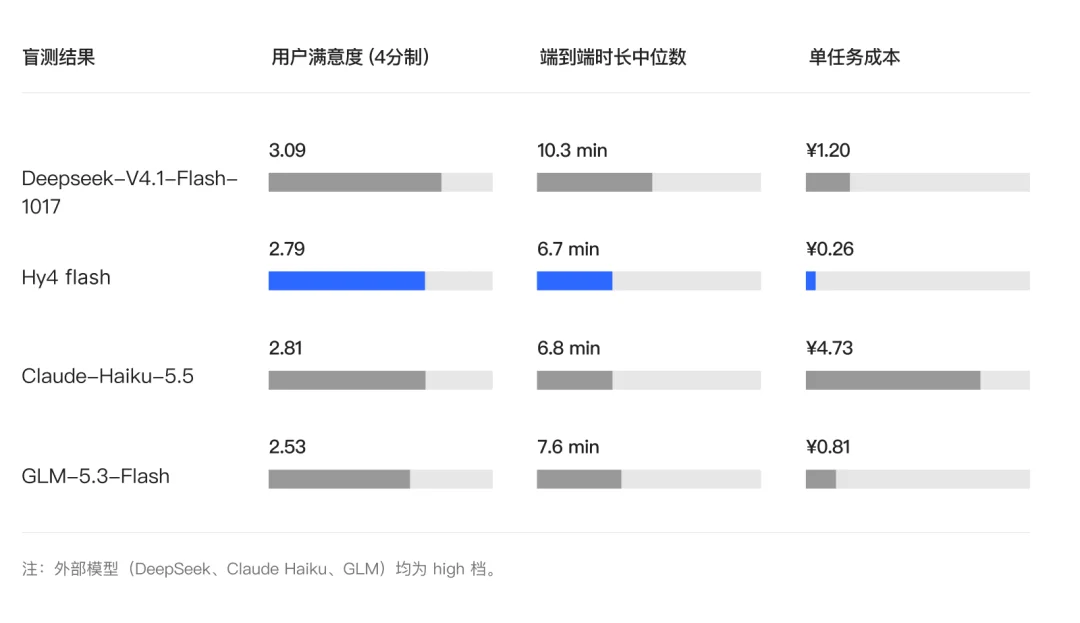
| Model | User satisfaction (4-point scale) | Median end-to-end completion time | Cost per task |
|---|---|---|---|
| DeepSeek-V4.1-Flash-1017 | 3.09 | 10.3 min | CNY 1.20 |
| Hy4 flash | 2.79 | 6.7 min | CNY 0.26 |
| Claude Haiku 5.5 | 2.81 | 6.8 min | CNY 4.73 |
| GLM-5.3-Flash | 2.53 | 7.6 min | CNY 0.81 |
Tencent highlights that Hy4 flash nearly matched Claude Haiku 5.5 on user satisfaction (2.79 vs. 2.81) at 1/18 of the cost per task. Unmentioned in the headline text is that DeepSeek-V4.1-Flash took first place at 3.09—0.3 points ahead of Hy4 flash—though it took 1.5x longer (10.3 minutes median) and cost 4.6x as much (CNY 1.20 per task).
In the WorkBuddy team's summary, Hy4 flash cuts average task duration by 70% and cost to roughly 1/15 of Hy4, matches it on daily office work, and shows a "slight drop on long-horizon coding tasks." Pulling the coding benchmarks out of the appendix tells a sharper story:
| Benchmark | Hy4 flash | Hy4 | DeepSeek-V4.1-Flash | Qwen3.8-Flash-Next |
|---|---|---|---|---|
| Terminal-Bench 4.0 | 19.2 (0.558) | 44.4 (12.014) | 40.0 (3.882) | 29.5 (5.100) |
| ProgramBench | 16.0 (0.561) | 30.0 (30.281) | 29.0 (9.214) | 22.0 (18.432) |
| DeepSWE v1.1 | 64.6 (0.290) | 74.9 (5.409) | 73.8 (1.304) | 65.1 (3.251) |
Terminal-Bench 4.0 falls from 44.4 to 19.2—less than half of Hy4—and ProgramBench drops nearly in half as well. Among the five Flash models, Hy4 flash posts the lowest DeepSWE score and beats only GPT-6 Luna on Terminal-Bench 4.0. Against the appendix numbers, "slight drop" understates the gap.
That matters directly for Claude Code users, since Terminal-Bench 4.0 was evaluated inside Claude Code.
Early community reactions split along that exact trade-off. On r/LocalLLaMA, user Hoppss remarked after reading the model card: "At a glance it looks like Qwen Flash Next is better for programming than this new one." User mechkbfan pushed back: "Yeah but also look at cost per task." Both points hold up in the appendix: Qwen3.8-Flash-Next scores 29.5 on Terminal-Bench 4.0 against Hy4 flash's 19.2, but costs CNY 5.10 per task versus CNY 0.56.
Tencent's own guidance draws the line clearly: use Hy4 flash for deep search, document processing, slide creation, simple frontend demos, and computer use, and stick with Hy4 for complex workloads like long-horizon software engineering that need a higher intelligence ceiling. In our view, Hy4 flash is the wrong primary model for Claude Code or OpenCode; it fits high-volume, lower-stakes tasks like reading logs, summarizing docs, and scaffolding simple pages.
Tencent also shared internal evaluation numbers from eight product teams:
| Product (evaluator) | Scenario | Baseline | Results |
|---|---|---|---|
| WorkBuddy (PM Anne) | Daily office tasks | Hy4 | Average task duration down 70%, average cost ~1/15 of Hy4; daily task quality roughly on par, slight drop on long-horizon coding; native multimodal |
| Yuanbao (Product Lead Logan) | Agent tasks, general chat | Hy3, GLM-5.3-Flash | Agent capability up 13.6% vs. Hy3, human GSB evaluation up 7.56%; general chat up 2.52% vs. GLM-5.3-Flash, with largest gains in multi-turn conversations |
| WeChat Pay (Information Intelligence Lab yilin, Security Engineer Simba) | AI-driven device testing on payment clients; static code scanning | DeepSeek-V4.1-Flash-1017 | Matched or beat baseline across execution path, knowledge use, acceptance checks, and test-account accuracy, with ~6% fewer steps and ~29% shorter single-turn output; static scan duration down 37% and tokens down 46% at equal accuracy |
| WeCom (Algorithm Lead Dylan) | Enterprise search, data analysis, document organization | Hy4 | Output speed up 88%; output tokens in thinking mode down ~60%; autonomously plans tool calls and delivers results |
| Honor of Kings (PM Lead TH) | Game dev bug root-cause analysis (UI interactions, system logic) | DeepSeek-V4.1-Flash-1017, GLM-5.3-Flash | Comparable localization accuracy; model requests down 22.0%–39.1% and receipt-counted tokens down 40.5%–61.2%; tool calls rose 51.2% and 7.7% respectively, while reports were 13.8% and 37.0% shorter |
| ima (PM Kaycee) | Knowledge-base Q&A | DeepSeek-V4.1-Flash-1017, GLM-5.3-Flash | Average wait time down ~18%–35%; overall answer score up 1.8%, content quality up 8.1%, chain-of-thought quality up 2.1% |
| QQ (Xiao Q Tech Lead Red, Channel R&D Look) | Xiao Q agent tasks; Channel Assistant UGC interaction | DeepSeek-V4.1-Flash | Pass rates up 6.16, 2.84, 0.92, and 2.22 percentage points across music recommendations, channel interaction, Qzone, and long-form horoscope analysis; completion time down ~11%–27% on chat, music, and horoscope tasks; Channel Assistant intent accuracy on par, P90 comment latency down 39%, peak latency down 47%, output tokens down 30%, and higher cache hit rates |
| Marvis (Algorithm Engineer Baihan) | AI assistant | DeepSeek-V4.1-Flash-1017 | Overall satisfaction on par; app installation up 6.2%, system settings and diagnostics up 4.4%, document processing and research reports up 6.9% |
All eight evaluations come from Tencent's own teams—mostly measured against DeepSeek-V4.1-Flash—with no independent reproduction yet. The Honor of Kings row is worth reading closely: while model requests and tokens dropped, tool calls jumped 51.2% against DeepSeek, meaning token savings did not translate into fewer tool invocations.
Because every benchmark and case study comes from Tencent, three details in the fine print matter when reading the numbers:
high.Tencent released three open-weight checkpoints—Hy4 flash, Hy4 flash-FP8, and the pre-trained base model Hy4 flash-base (not an instruction-tuned chat model)—on Hugging Face, ModelScope, and AtomGit (GitCode), with inference and fine-tuning scripts on GitHub. Hy4 itself remains closed for now, though Tencent says it is "coming soon."
For production serving, Tencent recommends vLLM or SGLang with FP8 weights across 8-way tensor parallelism, and ships a prebuilt vLLM image:
docker run --gpus all -p 8000:8000 --ipc=host \ -v ~/.cache/huggingface:/root/.cache/huggingface \ vllm/vllm-openai:hy4-flash tencent/Hy4-flash-FP8 \ --tensor-parallel-size 8 \ --speculative-config '{"num_speculative_tokens":5,"method":"dfly"}' \ --attention-backend FLASHMLA_SPARSE \ --tool-call-parser hy_v4 \ --reasoning-parser hy_v4 \ --enable-auto-tool-choice \ --served-model-name hy4-flashThe server exposes an OpenAI-compatible endpoint. Pass reasoning effort via chat_template_kwargs, setting no_think for direct responses without thinking:
from openai import OpenAI client = OpenAI(base_url="http://127.0.0.1:8000/v1", api_key="EMPTY")resp = client.chat.completions.create( model="hy4-flash", messages=[{"role": "user", "content": "Summarize this weekly report in three sentences."}], extra_body={"chat_template_kwargs": {"reasoning_effort": "no_think"}},)print(resp.choices[0].message.content)Tencent's AngelSlim team also uploaded a GGUF build, though the README notes it is intended only for end-to-end testing rather than production serving.
The 150+ tokens/s figure comes from Tencent's own infrastructure, with no public third-party throughput numbers yet. In the Hacker News launch thread, user vcryan wrote, "I love it. It's a bit slow," without specifying which provider they used. Another commenter, Rodmine, argued that "nothing beats Deepseek 4.1 flash on price/performance … (DS 4.1 flash is often available around 200-400 tps in Openrouter)," adding that Hy4 flash's smaller footprint should let third-party hosts serve it faster.
The weights ship under the Tencent Hy License (Version 1.0), derived from Apache 2.0 with a commercial Model-as-a-Service (MaaS) clause: companies offering MaaS whose aggregate worldwide gross revenue exceeds US$50 million or whose products have more than 100 million monthly active users must obtain a separate license from Tencent. Using the model and its outputs solely for internal purposes is exempt.
| Workload | Pick | Reason or trade-off |
|---|---|---|
| Docs, slides, spreadsheets, deep search | Hy4 flash | ~CNY 0.2 per task on WorkIndex; DeepSeek-V4.1-Flash scores higher on slides and doc editing, but costs 4–10x more per task |
| High-volume Q&A and chat where latency matters | Hy4 flash | Shortest median completion time in the blind test (6.7 min); cut ima knowledge-base wait times by 18%–35% |
| Coding and terminal agents in Claude Code or OpenCode | Hy4 or DeepSeek-V4.1-Flash | Terminal-Bench 4.0: Hy4 flash 19.2 vs. Hy4 44.4 and DeepSeek-V4.1-Flash 40.0 |
| Higher output quality when turnaround is flexible | DeepSeek-V4.1-Flash | Highest blind-test satisfaction (3.09); 10.3 min median, CNY 1.20 per task, half price off-peak |
| Visual reasoning with tools | Hy4 flash | Best in tier on ZeroBench (45.8), though lowest in tier on MMMU-Pro (75.8) |
| Self-hosting for external serving | Check hardware and license first | FP8 requires 8-way tensor parallelism; large MaaS providers need a separate commercial license |
CodingPass currently carries Hy4 (model ID hy4) on Go, Plus, and Pro, metered at official API prices; Hy4 flash is not yet listed. Since Tencent itself points developers to Hy4 for long-horizon coding, you can already run that workload through CodingPass. If you only need Hy4 flash for high-volume office tasks, calling Tencent Cloud TokenHub directly—especially at the 50% discount through November 30—makes more sense than subscribing for it. Check the models page for current allowances.
CodingPass includes Hy4, DeepSeek, Claude, GPT, and Gemini, metered at official API prices. No surprise charges, cancel anytime.